Showing posts with label women. Show all posts

Monday, April 4, 2016

Do we discriminate against ourselves?

My friend at work (let's call her Susan) was recently thinking about applying to become a supervisor. Susan exceeded all of the stipulations in the job posting including having over twice the number years of experience required. And yet, when Susan was thinking about applying she was legitimately concerned that she was not good enough to apply. Because Susan felt like if she was going to be THE female supervisor, that she had to be beyond kick-ass to set a standard for what a woman in that role can be. Otherwise, in Susan's mind they'd see her failures as a failure of women to be able to perform that role.

Yeah, from an outside perspective it's crazy for someone to feel that they represent their entire gender, race, religion, etc. But at the same time, in industrial engineering settings where there are few women in an organization, and even fewer (or none) in management - we do often hold other women (and ourselves) accountable for "representing women".


As I type this, I can hear how silly that sounds. But something about the environment makes me react when one woman is under-performing, or using what appears to be a "maiden in distress" tactic to get other people to do her job, or otherwise reinforcing negative stereotypes that are still prevalent in our work environment. Maybe it's because it brings me back to memories like when it was the middle of a big troubleshooting effort, and some guy who didn't know me assumed I was incompetent and made jokes about me being great for a secretary. And so later, I feel like a woman who doesn't "prove people wrong" is somehow losing ground that the rest of us are trying to gain. Women have been the industry for decades, and there must be a reason why we are treading water when it comes to the race towards equality.

I wish it was just me; I know that there are a lot of us who feel that way... But when I step back for a second, I realize that the women I'm judging for not "representing women" are not actually any worse than their male counterparts. Because I believe they represent us as a whole, my expectations for them (and for myself) are unfairly high. Just as my friend Susan's expectations for herself as a potential supervisor were unfairly high. As she described her "shortcomings" it was clear that she thought she should have manager level experience to perform a supervisor level role.

Whatever we want to call this mindset (which is a mix of imposter's syndrome and believing that we need to represent all women), we need to collectively snap out of it. No other woman represents us as individuals, and we don't represent other women. By perpetuating this thought process, and not applying to jobs when we are qualified (and not overqualified) we are becoming complacent in constructing the glass ceilings that limit us from progress.We shouldn't have to outperform men to be considered equals.


So give yourself, and other women, a break. Don't disqualify yourself from a position before you've even given it a shot, and try to not blame other women for causing discrimination you see in other parts of your life with their shortcomings. The only way we'll be judged as individuals (as we should be) is if we start to change the rhetoric.

Love,

Vanessa

Monday, February 23, 2015

Age != Experience

(Or Age Does Not Equal Experience, for those of you who aren't familiar with regex notation)


Ever since I was a child, I always felt like I was underestimated because of my age. I was lucky enough to have parents who treated me as an adult and took my ideas and opinions seriously even before I had graduated from Velcro sneakers or learned to correctly pronounce the word "vanilla". And yet, I quickly began to realize that other adults would completely discredit whatever children said based on the fact that we were, in fact, just children. I looked forward to the day I was 18 and  people would magically begin to listen to what I had to say without following it up with a "Did you hear what Vanessa said? That's so cute." 

My first engineering job was actually in high school, because I found another person who had faith in my work even though I had barely just gotten my driver's license. I had my own project, my own goals, and my own equipment, without the coffee-getting and copy-making that is normally associated with a high school job. My boss taught me how to dress, speak, and act like a professional instead of some ditsy teenage girl, and as people heard what I had to say, I noticed they slowly began to listen. The more people saw the work I produced, the more they ignored the fact that I had to go back to high school on Monday morning. To be honest, in the years I spent there I did more real "engineering" than I did subsequently.

I think this is what other people saw when I walked in the room
My 18th birthday came and went, and noticed that the bar for being taken seriously had moved up a few years. As I stacked on more accolades and years of experience, I got used to the fact that people would always either be surprised about my age (if they had seen my resume first), or not believe my experience (if they had seen me first). Eventually, I learned these two opposing perceptions of me would come to equilibrium because I worked hard and I earned people's respect when they saw what I could accomplish. But after almost a decade of having to constantly prove myself to doubters, I always thought there would be a time where I don't have to spend my first six months proving that I have some baseline competence. 

Fast forward to today, where I am well into my twenties, and in a required training class with other new hire engineers. I'm almost a decade younger than the next youngest person in the class, but have the second most years of experience in the industry.

One of the oldest men made a blanket statement of, "Yeah there are a lot of people here with very little experience before they got hired, like Vanessa." I turned to look at him, questioningly. "Well, this is your first job out of college, right?" he continued. 

"No..." I responded, a bit annoyed since we had introduced ourselves with our previous experience earlier that day. He either had the world's worst memory or was choosing to disregard what I had said. 

"Well, I mean you just came from that other thing, but it was just a co-op position."

"No, it was a job."

"Oh, so like an internship?" he smiled, as if he had caught me in a lie. 

"No, it was a job."

"But this is like, your first engineering job, right?"

"Nope, and it's not my second engineering job either..." My computer pinged, and one of the other guys in my class had just walked into the room and had IM-ed me 'Vanessa, be nice'. He's right, don't let this guy make you act unprofessionally, I told myself. 

"But you didn't do actual engineering before now, right?"

"I have been actually engineering things for almost ten years now," I said, being careful to control my tone so I didn't show my annoyance. 

"Well, okay then," he chuckled, turning away, and starting into some new conversation. 

While this particular experience is clear in my mind due to its recent occurrence, it's anything but rare and yet I'm still never sure how I should respond. Should I keep copies of my resume stamped by a notary? Should I have them Google me so they know I'm not full of shit? Should I just laugh it off and let them think that I'm an incompetent young fool who was accidentally given a job she didn't earn?

I know that my other young female overachiever friends often report similar experiences to me. And, while I presume some young male overachievers experience the same thing, I've never witnessed it, and my friends have not admitted such experiences to me. As a result, I'm unsure how much of this has to do with being young, and how much has to do with being a young woman. But either way, I don't see a clear way to tackle this systemic issue more than one experience at a time, except by rising above it myself. 

In a lot of ways, it's these experiences that drive me to be the exception to the rule, like my first boss. To listen to what people have to say regardless of whether they are 5 or 30 or 63 or 92. To judge people based on their potential and their accomplishments. To take everyone seriously from the moment you meet them, and base your opinions on facts and not assumptions. If we can each try to do these things ourselves, then perhaps it will start to dwindle as a problem overall.

Love, 

Vanessa

Monday, December 8, 2014

Nerdy Christmas Gifts

How frustrating is it when every time you search for "gift ideas for nerdy girls" or "gift ideas for the college student" you end up finding a bunch of electronics or something useful that has been made nearly useless by making it into a Doctor Who Tardis shape or a Minecraft Creeper form? When we am looking for cute nerdy gifts for our girl friends, we want something that has a subtle hint of nerd, not a blaring neon sign saying "NERD ALERT HERE." We're proud of our nerdy heritage, but we still want to be both functional and fashionable.

To help you solve this problem, we (Ruby and Vanessa) created a list of gift ideas for your nerdy girl friends. We aren't getting any sponsorship out of this (even though this seems like a giant Etsy add). Mostly this is a list of things we found to be awesome and would secretly like one of our friends to find, be influenced by, and buy for us this holiday season. *hint hint*  If you don't like Pinterest, then you should probably just come back next Monday when we write something more substantial and aren't just posting links and photos.

Jewlery

Jewelry is a simple gift, but getting something that re-purposes electronics and other engineering things makes it unique and more thoughtful than your standard pair of cubic zirconium studs. It's only secretly nerdy, because most "regular people" don't even recognize this stuff as being related to engineering.
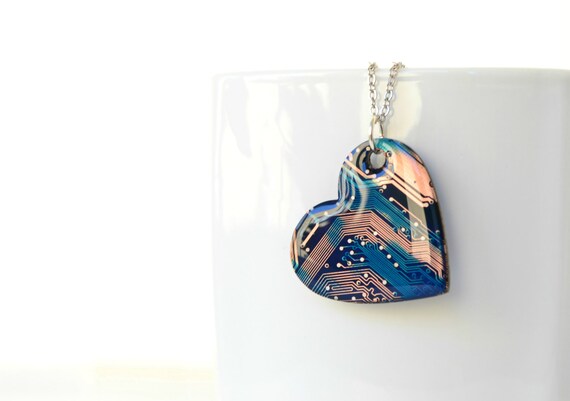
Geekery Heart Necklace - Circuit Board Heart Jewelry - Steampunk Industrial Jewelry - Nerdy Geek Love
This necklace is geeky, but totally wearable. It's $31 on Etsy.  

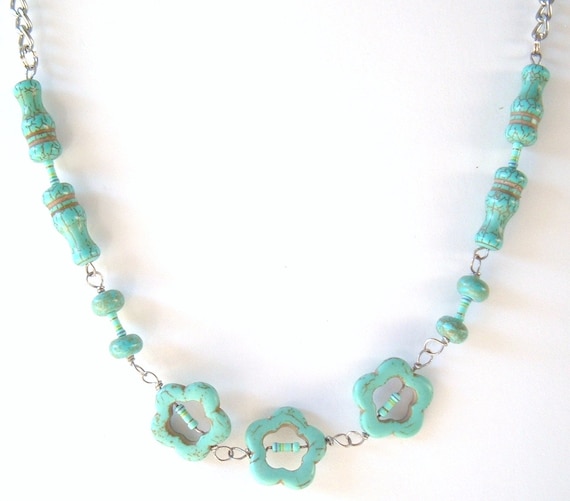
This necklace is handmade, and can be found on Etsy for $20
If your scientist/engineer is not really into electronics, you could try this cool solar system necklace (which is being sported by the Chief Scientist at NASA so you know it's out of this world)...
This solar system necklace was worn by the Chief of Science at Nasa! It is $400 though, so perhaps out of the average price range.
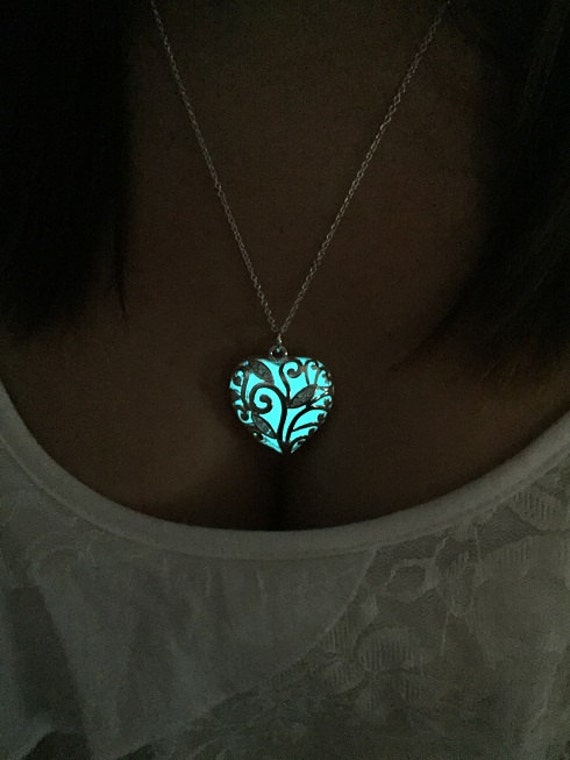
Maybe that engineer likes cool materials, which would make this glow in the dark necklace a pretty sweet gift.
It's $31.95 on Etsy.

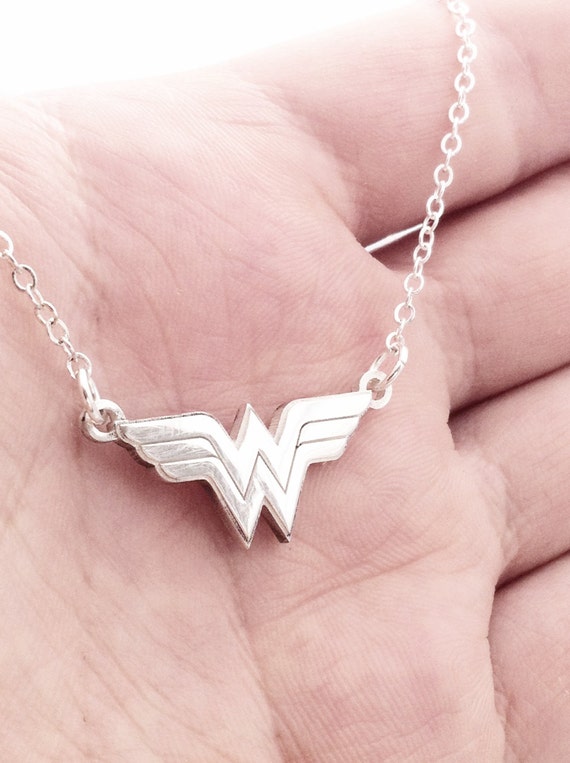
Or you can always go the superhero route. Here is an example of a superhero piece that isn't too bling-y or blaringly obvious.

This Wonder Woman necklace is $49 on Etsy

Other Wearable Things


This T-Shirt comes in all sorts of colors and sizes and cuts, and is $28. 

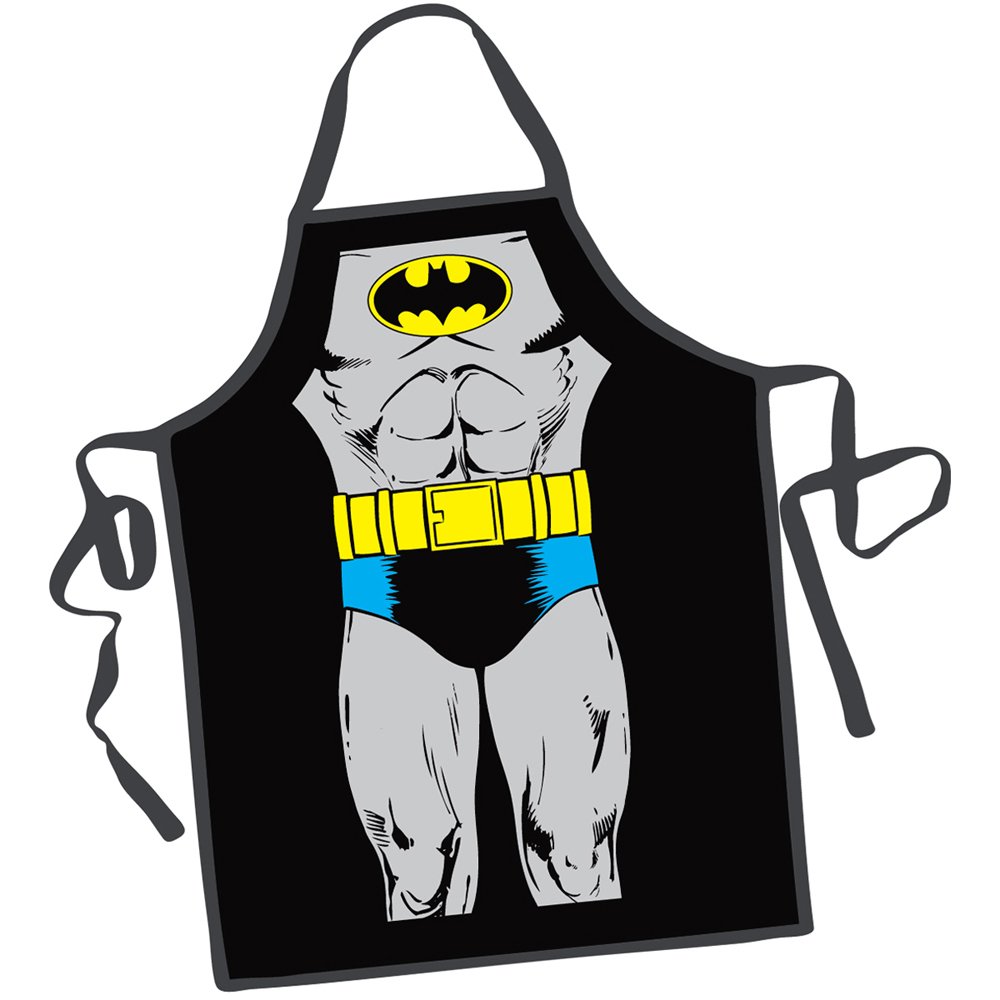
And while we're still talking about clothes, what about the batman apron. It's not subtle, I grant you. But it is both nerdy and practical if you have a nerdy friend who likes to cook. Or in Ruby's case, if you're a nerdy girl who likes to bake and bake and bake. It also has the added benefit of supporting your friend's habit of feeding all of her friends tons of sugary treats. This means that she (and you since you know her secret) can look good next to them in all the holiday pictures this season. 

Note, these aprons also come in other superhero options like Captain America, Iron man, and others.  

Christmas Tree/Hannukah Bush Ornaments

Einstein Ornament $12.50
Darth Vader Ornament $27

Odds 'N Ends

Okay, I straight up give up on trying to even categorize these things. 
I didn't even know coffee stencils were a thing, but these are $24 for a set of 3
Tap into her creative side with this cool 3D pen. It combines some interesting science (electronics, materials science, even structural stuff), with out of the box thinking and is just all together cool.


Or if your nerdy friend is in the car a lot for commuting to and from her off-site plants, conferences, and meetings, an audiobook can be a practical and thoughtful gift. Plus, something as amusing as "Confessions of a D-List Supervillain" is going to have her considering becoming a super villain herself and joining the dark side of the force.

You can get this from amazon here!

No matter what you get or give this holiday season, we here at Pocket Protector and Heels wish you all a very happy holidays!

Love,

Vanessa and Ruby

PS. What "nerdy" things are you hoping for this holiday season?


Monday, October 6, 2014

Scary Cool Science Projects

October means it's almost Halloween. Which means there is an excuse to embrace your inner mad scientist and make some creepy, crawly, sticky, oozing masterpieces. One of the first ways I got involved in engineering was actually tricking out my house as a kid with special effects to scare unsuspecting trick-or-treaters.

So here are a few fun little projects for you (the kids are totally optional):

Oobleck (a classic)


At Halloween,  a good back story for this (because every good halloween tale starts with a scary story) is that you have found a special material that defies worldy laws of material.


Set the stage by letting your subject put their hand in a bowl of water. Note how the water reacts as a fluid. How motion is permitted no matter the speed. Now have the subject put their hand on a table. This is a solid (obviously)  and note how no matter how fast or slow or how hard or soft you push, the table provides equal and opposite force keeping your hand still. It seems silly to go over these obvious actions, but this understanding is crucial to showing why Oobleck is so unusual (it's a non-newtonian fluid).

Make Oobleck with this recipe (if you are working with a kid,  let them measure out everything and put it together with your instruction).

I suggest using some green or red food coloring.  Once you have the oobleck, remember what you previously determined about solids and liquids, and then explore the behavior of your new alien creation.


Send Letters With Disappearing Ink


Ruby suggests two possible scary set-ups for this project: leaving secret wolf paw prints, or writing letters to Halloween ghosts.You can order disappearing ink online, or make it using these instructions or these other instructions. Make sure to discuss the chemistry behind what is happening, and how it might impact other things in the world around you. Ask them to come up with ideas of when they might want or need to use something like disappearing ink.

Dry Ice Fog and Fun 


Make sure to use proper safety precautions when handling dry ice, and communicate these precautions to any kids involved. Dry ice and hot water can make a cool, creepy fog. Try using these instructions for a basic dry ice fog. 

If you want to step up your dry ice game, Steve Spangler has some great ideas for cool experiments with dry ice. The following video is an example of some of his ideas, no copyright infringement is intended. 


Yes, all of this is fun to play with, but it is also really interesting science. Talk to the engineer-in-training about different forms of matter. A great example to discuss is water. The solid form is ice, the liquid form is water, and the gas form is steam. When H2O changes from an ice cube, it melts to water before it becomes steam. Dry ice experiments are a great example of sublimation, where matter is able to change directly from solid to gas forms. Here is some more scientific information about dry ice if you want to know more.


Electronic Special Effects


If you are looking for an electronics project, this website has some instructions on how to make a rustling leave special effect to spook some of your trick-or-treaters. Be sure to use proper precautions when using soldering irons, or just use a breadboard instead. If you don't want to go through the whole process of making your own special effect, get one of those tacky (read: awesome) animatronic Halloween decorations and take it apart. Figure out what the different parts do, and why they work. Does it use a light sensor? What does the sensor look like? How does the animatronic make sound? How does it move?

Whatever projects or experiments you decide to try, encourage kids to ask "why", and "how" all of these experiments work. If you don't know the answer (or even if you do) go to a computer or a library or a text book, and help them learn how to look up the answer. Perhaps the most helpful part of experiments is teaching them how to question the world around them. It's that questioning attitude that is the foundation of a great engineer or scientist. 

Love,

Vanessa

PS. What are your favorite ideas for creepy science experiments and projects?

Monday, September 8, 2014

The "G-Word"

As I was in the middle of checking a calculation at work today, my phone rang and when I picked it up a woman on the other end said, "Hey girl!"


Did she really just say "hey girl"? I paused, at a complete loss for how to respond. Thankfully, she quickly filled the silence with technical questions and it was back to normal work. But my momentary discomfort reminded me of an incident that had happened years earlier.

In college I was on the executive board of an organization for women in technology that provided a professional and personal support network. I loved the organization, and always looked forward to crafting funny and welcoming emails to go out to our members about the upcoming events we had planned.

One day, my adviser emailed me asking that I come to her office- and the tone sounded more serious than normal. I sat down tentatively, and she took in a deep breath.

"Vanessa, we need to talk about your use of the 'g-word'," she said very carefully.

"Excuse me?" I asked, completely confused.

"The 'g-word'. You've been using the word 'girl' a lot in your emails and I've been getting complaints from some of the members that it's offensive and demeaning. I know you wouldn't intend to offend anyone, but you should probably choose another word."

I was honestly pretty shocked; I hadn't intended to offend anyone. I just wanted to make it sound welcoming and fun.While 'girl' can refer to a child, it can also just refer to a young woman, or a woman of any age. When starting an email, "Hey women!" sounded too formal and awkward, "Hey ladies!" sounded too sassy, and "Hey gals!" sounded like we are from the 1950's. I mean, 'girls night out' isn't demeaning, it just sounds like fun. How else was I supposed to address a group of women? How could a word that I always associated with fun be offending people?

What place would ever advertise a "women's night out"? It just sounds wrong.
I followed my adviser's advice (because she seemed to always be right about these things, even if I couldn't explain it), but it wasn't until I graduated that I began to truly understand why anyone would find this word off putting.

The only time I heard the word 'girl' at work in the first couple of years was dripping in venom. Men who were annoyed with me (or the rare other woman) would say things like, "Tell that girl that I don't think I should have to do that" or "That girl is being unreasonable". The passive aggressive vendor I mentioned in the email blog post is the perfect example of the type of person who enjoyed using the g-word. It was almost like they had done a one for one word replacement with 'bitch', and thought they'd get away with it since 'girl' wasn't technically a bad word.


I suppose they could have used 'woman', 'lady', 'person', 'human', 'engineer', 'genius', or really any word, and you would have been able to hear the same poison and disgust in their tone. But the perpetrators always chose seemed to choose 'girl', perhaps because it had the bonus implication of being young, inexperienced, and immature. As a side note, I always found that ironic because I think that debasing yourself by insulting people at work is rather childish.

That's how I ended up today, answering a phone and feeling momentarily shocked and defensive at a word I used to associate with fun social events. For the first time I can remember in my professional career it was meant in a nice way, so my defensiveness was unnecessary. But I couldn't help but wonder how a seemingly benign word had become such a weapon in the workplace.

I know that there is a pretty awesome, similarly themed P&G commercial about reclaiming the phrase "like a girl", although it mostly has to do with performing physical activities "like a girl". I think it's important to take that one step further; being young woman has nothing to do with competence physically or intellectually. In the workplace, I have been told that the word 'girl' is never appropriate. Admittedly, when it is used by the older generations, it almost always seems to be used in the form of an insult. But perhaps by banning the word we are unintentionally admitting that being a young female is somehow a bad thing.

I am a girl, even though I am not a child. My gender and my age have nothing to do with the quality of my work. Maybe the solution isn't discouraging people from using the word "girl" altogether (and therefore giving it even more power when used negatively), but using it more often in a positive context reclaiming the word and removing the negative stereotypes. What do you think?

Love,

Vanessa

Monday, August 25, 2014

We Are The 62%

If you've been browsing the internet reading about women in engineering recently, chances are you've seen one of the articles that talk about the NSF/ University of Wisconsin - Milwaukee study which found that only 62% of women with engineering degrees are working as engineers. The presentation is actually quite interesting, so you should give it a look. The study included female alumnae from the 30 universities with the most engineering graduates, and from the feedback snippets in the linked presentation- it seems like they got some pretty honest feedback.

But the research isn't done. The research description for the ongoing study says:
"We are surveying a national group of engineers who are currently working as engineers. This research will help us gain an understanding of the most important things that have led to engineers career choices. The results may help us make recommendations for improving the working environment for men and women in engineering careers."
So while I'm not affiliated with this study in any way, I'd encourage you to participate and send it to your friends (male and female) in engineering. As you already know, having a complete data set is important for ensuring accurate results, and studies like this have the potential to help our field evolve. I'm one of the 62% of women who are still engineers, and I for one would love to see an environment where people are happy enough to stay.


Love,

Vanessa

PS. What are your opinions on the first study? Do you identify with the results or disagree?

Monday, August 18, 2014

How To Make Yourself Heard

My first week at my new job, my supervisor asked me if I could quickly come to a meeting with him. I had no idea what the meeting was, but I swept my notebook off my desk and followed him through the maze of hallways to a conference room. Once I crossed threshold into the war room and noticed the sea of leather notebooks and iPads I realized that these were not fellow engineers. In fact, it was a meeting of supervisors, managers, and directors. But since I was totally new and hadn't met any of them yet, I could only tell that they were important.

WHAT AM I DOING HERE? I panicked. At my last job, my supervisor always briefed me days in advance if I was going to meet anyone important so I had time to prepare my presentation and not look like a total nincompoop. Given at the time I thought his briefings were totally unnecessary, but finding myself in some mystery meeting I began to wish I knew anything about what I should expect.

My supervisor motioned to a plush leather chair next to him, and I nervously sat down. A commanding middle aged man walked into the room, and the other men all fell completely silent. They began to discuss business, training of new engineers, who had been fired, and the path they wanted to take to success. On one hand I was excited to get to hear this information first hand, on the other hand I felt like I was peeking behind the curtain and I would be in trouble if anyone noticed me there. Maybe if I just leaned back a little I could disappear. Or maybe that would make me look lazy. Maybe I should be taking notes. But since none of these were action items for me I might look like a secretary.


And then, all of a sudden, the commanding man turned to me, "And what about you? Do you have anything to add? I'm sorry, I don't think I've met you yet..."

"Vanessa," I choked out.

"She's a new engineer here," my supervisor said.

"Well, Vanessa, do you have anything to add?"

Was I supposed to have something to add? What do people normally say? Am I missing some social cues here?


"Um, no," I smiled weakly, hoping the pathetic smile would help lessen the blow if I was expected to have some ground breaking answer.

"Okay," he said, moving onto the next subject.

It was the first time in ages I'd been afraid to speak up during a meeting, and I was ashamed of myself. I'm not a shy person by nature, but I was so distracted by mitigating the consequences of saying something off point that I ended up saying nothing. And when I say nothing (especially when asked) people presume that I have nothing to say, effectively causing the same problem if I had said something idiotic.

I wish this was just a personal problem, but research shows that in collaborative environments women spoke less than 75% of the time of their male counterparts. So apparently, I'm not the only one with a propensity for psyching myself out in a meeting.

Feeling like my voice had been stolen by a sea witch who had given me the chance to be a real engineer for a day was something I was familiar with from my intern days, but was a habit I kicked when I really listened to what other people were saying. They were not more qualified to speak than me, and my conclusions were no less valid that theirs. As an engineer, I am paid for my ability to solve problems. If I just sit in a room like a bump on a log while I let others solve the problem, I am not really doing my job.

If you don't get this reference, you got some Disney to watch.
So, I started speaking up in meetings. The first couple times it came out sounding more like an apologetic question than actual feedback. But eventually I became a regular participant in meetings- unabashedly sharing my knowledge and even disagreeing with other people when I felt otherwise. This isn't a business where they pass around a sharing stick to make sure everyone feels included, so if I had something to say I made sure to interject it. That didn't mean that I would chat through the entire meeting and make unfounded statements. Just that I was no longer afraid to act like people should respect my opinions. The world didn't implode, and once I learned how to speak in statements instead of questions people took my input seriously.

After years of practice it was second nature, which is what made the most recent case of meeting jitters so strange. Luckily it seems like it was a result of me not knowing what to expect and I've already gotten it back under control.

Have you ever had a tough time speaking up during meetings? How did you convince yourself to speak up?

Love,

Vanessa

PS. If you like what we write be sure to subscribe, share this post, and leave a comment below!

Wednesday, May 28, 2014

The Contracting Lifecycle

As I've mentioned before, I work as a contract engineer. While my title and company remain the same from month to month, my projects and clients are transient. After months of working closely with clients on a project, when I've finished the job I pack up my laptop bag and move on. Sometimes I'll end up working with the same people in a matter of days, sometimes I won't work with them for a year or more.

Leaving at the end of a project can be kind of awkward and anticlimactic; people don't know if they should make some grand gesture to say goodbye, or if they should just say "have a nice life" and move on. One client insisted on me stopping by his desk on my way out after completing a six month project.

He shook my hand and proclaimed, "It's been a pleasure working with you. You've done excellent work here."


Yet somehow after six months of pouring my heart and soul into the project, even that kind ending felt like I'd lost something. For six months I had talked with the same cast of characters every day, stayed in the same hotel, and even eaten lunch at the same table in the same chair at the the same time with the same friends. And while I was doing so much the same, I felt like I was changing my environment. I fixed a complex system, I got two divisions who hadn't worked together in over a decade to play nice, I created real friendships, and I earned the respect and trust of people who had initially doubted me. As a result, I felt like going back to my "home office" meant that I was losing my new friends and that I would not get to enjoy being the respected engineer I had become.

This isn't to say that there aren't times when I am not super excited to get off of a project (because there are), or that I would ever try to extend out a project to keep my life constant (because I wouldn't). Just that as I was walking out of my client's office on the last day, I felt a sense of loss even though it was another win on my resume.

I definitely moped around  internally for a few days upon returning home, although I was all smiles when coworkers I'd spoken to once a year ago greeted me back to the office like a long lost sister. I can never tell how to deal with people who proclaim how much they missed me when I don't even remember their name. Luckily for me, by the end of the week I had another assignment at an old site but with a new team.

After walking through a cubicle maze which doubles as a menagerie of old clients and friends, I headed into a room of unfamiliar faces filled with doubt at who this stranger was. I could tell they were wondering if I was truly capable of helping, everyone does at the beginning. I took a deep breath, and braced myself to start from scratch again. This time, I told myself, it would be easier since my reputation preceded me. I extended my hand to each man in the room (since there were, of course, no women) and said, "Hello, I'm Vanessa. I'm the lead engineer for this project."

When you keep going around, it's hard to feel like you are moving up.
When it's all said and done there will always be an expiration date, and there will always be a new project, and a new team. The trick for me is allowing myself to care deeply about each new project regardless of the expiration date, as that is what drives me to succeed. The projects may be temporary to me, but they are permanent for my clients.

Love,

Vanessa

Monday, October 21, 2013

How to Pick A Cute Work Hairstyle

I apologize that I missed last Monday's post. I'm going to try post two times this week to make up for it (insert gasps and cheers from all 20 people that read this blog regularly and never comment). This week I decided to go with a less substantial topic that still impacts engineers: hairstyles.

In an all male environment, it's hard to find inspiration for ways to spice up boring hair days. Something about wearing your hair completely down and having it look nice by the end of the day is a concept that completely evades me. Perhaps it is because of the hardhat I have to occasionally don, perhaps it is my hair's natural proclivity for knots,  or perhaps I just fidget too much. Any way you slice it,  I need a hairstyle that is cute while still being durable enough to deal with a full day of work.

Everyone has a day like this sometimes...

While I considered posting pictures and instructions for the different styles I like, I realized this is a solved problem and that there are in fact dozens (if not hundreds) of videos that show how to make every hairstyle I feel like I've invented. To that end, I scoured YouTube for engineer-proof hair tutorials, and have come up with the following:

Hair Tied Ponytail 

The simplest of these hairstyles is a sleek way to spice up the average ponytail. Hair wrapped ponytails hide your neon hair elastics, and make the hairstyle look office appropriate.


Rave reviews from one coworker say, "But...  Where does your hair end? "

French Braid Side Ponytail

This is a slightly more complex variation on the side ponytail. It only takes 10 minutes or less to do in the morning, so it won't cut back on your much needed sleep.


What my coworkers have to say about it: "Vanessa,  your hair confuses me."
"You must have magic to make hair do that."

Braided Bun

The braided bun is a great way to get a sleek look quick, when your hair is not cooperating. Cons are it isn't necessarily good for a hard hat, and it uses an ass-ton of bobby pins (which is relevant for workplaces which regulate the amount of metal you have). 


One day,  when I was wearing my hair in a Braided bun,  my coworker found a bobby pin on the ground. While I was minding my own business typing an email,  he slipped it into my hair and said, " I believe this belongs to you." Truth is, he was probably right because I was the only one wearing my hair up, but it was VERY uncomfortable anyways.

Side Bun

I'd love to say that I wear side buns instead of regular buns because they are more fashionable. But the truth is, my preference for side buns over regular buns is a result of the fact that regular buns make driving in a car quite literally a pain in the neck. There is nowhere to put your head that isn't super uncomfortable. I would venture to guess that the longer a commute a woman has, the less likely she is to wear a huge bun protruding from the back of her head.

So if you love buns, and hate neck-aches, here is a tutorial for how to make a quick side bun:


Standard fair. Poorly done you look like an angry librarian. Well done,  you look like you mean business.

Hairband:


Especially if you have shorter hair,  this is the easiest way to look like you tried with minimal effort. I recommend doing a side part,  or letting your bangs fall normally (if you have them)  so your bangs don't look like somebody out of an 80s work out video.

If you don't know how to use a hairband yet... than here is 5 ways to do so:


I go through prolonged hairband phases, and they usually involve solid colored hairbands. Although, I will admit that I was involved in the blinged out butterfly and flower hairband phase and am not entirely over it even though I am aware it is socially unacceptable.

That's all for now. Variety is the spice of life, so try a new hairstyle tomorrow!

Love,

Vanessa

Monday, October 7, 2013

First Impressions of New Hires

Disclaimer: This is not meant to scare you, just to share what happens in my non-conventional work environment. It is meant to inform you, but not to make you paranoid of every nice gesture on your first day.

So here is the honest truth about what happens when a new girl  has joined one of my companies where there are over 80% men. The biggest thing to understand is that men and women in this environment have adjusted to the fact that female engineers are as rare as a rainbow unicorn. So when a new woman starts and people don't know who she is, chances are people will bet that she is a secretary, marketer, salesperson, or any other non-engineering job their company has. This has something to do with the fact that women tend to dress up for their first day in a stereotypically "non-engineering" or feminine way (I spent over an hour getting ready before my first day of work), and something to do with the fact that statistically the new girl is almost never an engineer.

Wouldn't you be surprised if you worked with a unicorn? 
Once everyone meets her, people tend to place the same sort of bets on who will be the first one to ask her out, date her, fuck her, etc. It's wildly inappropriate, but it happens consistently in my workplaces and can range from more innocent comments to very explicit statements. For the new girl, the awkward onslaught of people hitting on you can be very uncomfortable when you are just trying to figure out how to charge the time you work and where the bathroom is. 

The majority of guys involved try the awkward engineer approach, like the one who told a new female engineer on her first day: "I really love the way you wear... colors. You really pull it off." Others will drop more standard pickup lines into work conversations, or invite the girl to spend a weekend with him at his lake house. It all sounds innocent enough, but everyone else can hear these conversations from their cubes. In my opinion, a lot of it is done for show and the woman is often established as the "new woman" and not as the "new engineer". While I don't believe the men intend to be vicious, I do think that it creates an environment where women are initially not taken as seriously as their male counterparts.

I'd like to point out that none of the female engineers I've worked with have actually dated or slept with one of the men involved in these bets. Usually it just means that all of the guys are overly nice to the new girl, and that there are a few awkward conversations. 

It's not just men who can make the transition awkward for new female hires. Note I said earlier "people tend to place bets" and not "men tend to place bets"- some women make similar bets on who will be the first to hit on a girl. This is interestingly usually done in a way offensive to the man, as if he is so desperate he'll hit on any new person he meets. 

In addition, the female engineers will have one of three reactions to new female hires in this environment. The first group will not care at all, and will react the same for male and female employees. The second will have a strong negative reaction to a new woman because they will have less attention and some even feel like their job is less secure. For example, if there are only two women at the company, it is hard to fire one without seeming sexist. But if there are four women, firing one of them seems less sexist and more that the woman was under-performing. The last group will be super excited to have new women in the office, as it may help change the testosterone filled environment. I am somewhere between the first and third group, since I'm pretty excited for new hires in general but I enjoy having a coworker that is guaranteed to not try and talk about his dick.

Is there room for more than one unicorn in an office?
The women end up usually coming around within the month when they feel more comfortable that their position is safe, and usually the original "challenge" phase is over for the men when they realize they can't win you like a prize at a carnival.

If you find yourself with some overly "nice" brand new coworkers, try not to worry about their possible bets and bullshit. Your new coworkers don't expect you to know about any of this, so you can't exactly address it head on. Take help that is offered to you while maintaining professional behavior, and use their eagerness as an opportunity to get yourself up to speed as quickly as possible. You'll soon find your niche at work, and prove to everyone that you are competent and they are lucky to have you on their team for your skills (not your gender). 

The easiest way to change this environment is by proving it wrong one awesome scientist and engineer at a time. So go ahead, take that hour to get ready for your first day at work if you want to, and bust some stereotypes. 

Love, 

Vanessa

Monday, September 16, 2013

How to Own at Engineering Career Fairs

It is that time of year again! The sweet smell of panicking students wafts through the air as they nervously mumble their elevator speeches to themselves on their way to class. Maybe it feels like you just did this last month, maybe this is your first time. Regardless, let me welcome you into the world of career fairs.

Engineering career fairs in their purest form are a very different beast from any other type of event. Eager students will wait in lines for over two hours for a chance to talk to a recruiter for two minutes. There isn't any pushing or cutting the line (which I hear happens at business fairs) because engineering jobs all comes down to your skills, not your aggressiveness.

The range of what companies expect and look for in a prospective intern/employee is fairly extreme. Some companies won't take you seriously if you don't make the effort to wear a suit,  and others will pursue you harder if you come in an old set of sweat pants and a tie-dye t-shirt. The latter company tends to believe if you show up in your pajamas, you are probably smart enough to not need to compensate with style. Other companies will see this as unprofessional and lazy, and will immediately disregard you as a potential employee.

So how do you know how to prepare yourself? Get in touch with your inner nerd and research the companies before you go! When I attended fairs I made a spreadsheet with the company name, field of work, open positions, and ranked each one in terms of my interest. With a little additional research on my top ten picks, I would go into the career fair prepared to make everyone feel I'd come specifically to see their booth.

I realize that  this might sound over-the top to you, but even if you aren't feeling particularly inspired you should at least do the following:
  • Print plenty of copies of your resume.
  • Leave your cellphone behind. You don't need any extra distractions and the risk of your alarm going off is not worth it.
  • Prepare an elevator speech which highlights your qualifications.
  • Wear a conservative outfit, with shoes you can actually walk in.
  • Get somebody else to approve your makeup and hair before you go inside. Don't wear clown and/or street walker levels of eye shadow and lipstick.
  • Bring a professional looking bag to carry all of the "swag" (aka crap) that the recruiters hand out.
In "normal" career fairs this is the end of required preparation. But in engineering career fairs, it is not uncommon for employers to require on-the-spot verbal or written exams to prove basic technical competencies. If you really have your heart set on a position with a specific company, research this beforehand, too. Study any of the languages, computer programs, or skills your dream company has listed as preferred because these quizzes can really cover anything.

For example, when I was a freshman in college, a recruiter handed me a paper after five minutes of talking about my resume: "If you don't mind, I'd like to ask you to take this quiz so we can determine your level of programming skill and where you would best fit in our organization."

Me: "Sure,  no problem."

I sat down at their quizzing desk and read the first question. It wanted me to write a short programming script to solve a problem in a language I not only didn't know, but had never even heard of. I didn't know the syntax, I didn't even know if it was object oriented or not. All I could think of was how awkward it would be for me to just cut my losses, slink away from the desk, and just pretend it never happened.


I glanced up, the recruiter was standing with her arms folded, watching me. Fuck. This was going to be really awkward. So I just wrote the answer in a different programming language, and on the last page I scribbled the word "Sorry."

I stood up, smiled, handed it the damning exam to the recruiter after having come up with no inconspicuous ways to accidentally drop it in coffee or otherwise destroy it, exchanged a few pleasantries, and then booked it away from their booth as fast as possible. Needless to say, I didn't send a follow up email.

Everyone has an awkward experience sometimes. But just go ahead, collect yourself, and move on to the next booth. The very next group I talked to that day had an exam on systems that I excelled at and I walked away with an interview for the following day.


So my advice is: do your homework, and then go in confident of your skills, look those recruiters in the eye and convince them of the truth: they would be lucky to have you on their team.

Break a leg!

Vanessa

Like what we have to say? Subscribe to Pocket Protector and Heels with the RSS field on the right hand side of the page!

Monday, September 9, 2013

How to Spot a Good Manager

Vanessa tells me that while I talk a lot about what it's like to be a new engineer in the field, I don't talk frequently about what it's like to be a female engineer. I don't talk a lot about gender roles in engineering because I don't feel I have as much to contribute on the topic as most other women in engineering. This is because I work at an engineering company which has close to 50% women, which is is kind of like stumbling into cave full of already-mined, already-cut 30 carat diamonds after stumbling through a cave of already-mined gold. I know that you're thinking, "liar, liar, pants on fire! No engineering company has that many women!" But it's true.

This is how I imagine we would interact if/when I mentioned the gender distribution at my firm in a face-to-face conversation.

And there is more. Not only do I work with a decent number of female coworkers, but there are also a fair number of women who are managers at the company. Yes, my boss is a woman. To top that, my boss' boss is a woman and my boss' boss' boss is a woman.

So, you see, I'm not the most informed source when it comes to engineer workplace gender inequalities. I do, however, have a bit more insight into women in management. I compiled a list of the women in management, categorized them into good managers and poor managers, and compiled a list of common traits for each category. This list is solely based on female managers, but looking back at it, it's clear that it's applicable to both genders. Anyways, onto the list.

In my opinion, there are a few things that good managers will do:

Maintain realistic expectations
For me, what truly makes a manager stand out is that they are realistic and that they maintain focus. They know that ideals are great, and can be pursued to a certain extent, but you must keep your eye on the prize at all times. These managers accomplish a great balance between encouraging scientific inquiry and requiring deliverables which will meet business needs. They allow time for your pet projects (e.g. investigating a really weird observation, which could result in a new discovery and published paper), but also keep the main focus on the business needs (e.g. that equipment redesign plan that's necessary to for the next phase of the project).

Give praise when praise is due
Another common theme with some of my awesome female managers is that they know when and where to give praise. An ideal manager will give praise regularly for big-ticket projects and occasionally for doing a good job in general. Praise should be given regularly, but not too frequently.

Poor managers have a hard time balancing the correct amount of praise. Some will praise you too frequently, which doesn't seem like such a horror until you realize that they're praising you for things that don't merit praise (e.g. taking meeting minutes). Then, when they do praise you for big-ticket projects, it no longer feels like an accomplishment because your epic three-week intense project got the same response as taking meeting minutes.

Other poor managers will praise you too infrequently. In these cases, the managers don't appreciate your work, nor your many unpaid overtime hours, nor having a project be well-received by a client, nor that you saved their files from an untimely coffee spill. All of these acts are worthy of praise, especially that last one, of course. The bosses who cannot see that such acts are worthy of praise can pretty much be described in one word: "grumpy." I've seen first-hand how a lack of such praise makes employees feel defeated and thus think that overachieving will never be worth the effort.

And here are some things that a good manager will not do:

Disrespect the underlings
I had one manager who told me to my face that she knew more about science than I did, even though her degree was in business management. Telling anyone that their knowledge is inadequate when they've worked and studied hard in the area is going to hurt them. Plus the underling will know the manager is full of crap and lose respect for the things they do know about.

Be a slimy politician
Seriously. Reserve politics for the actual politicians, the ones who think they run a country and who like to talk circles around the issue. If your manager thinks she's a smooth talker, then I can almost guarantee that her underlings think she's a lousy scientist and a panderer. That manager tends to make life harder for their underlings. Because let's face it, smooth talkers make impossible promises. And then the underlings either have to bust their butts to meet unreasonable deadlines or deal with falling short when the deadline arrives.

Do not be indecisive and inconsistent
That one's pretty much self explanatory. Good managers aren't wishy-washy. Good managers don't change their minds (unless it's justified by new evidence). And good managers have their thoughts organized enough that they remember what they've previously decided. It's a waste of time to convince someone of something you've already spent an hour convincing them of earlier that week.


If you look at the list, you'll realize that there's no reason the same exact list can't apply to men. I have never seen any particular drawback which is specific to one gender or the other. In my mind, if you're a good manager, then that's the end of it; management skills aren't attributable to gender. The female managers I have dealt with aren't catty, bitchy, or any of the other stereotypes engineers often think define a women in management.

However, I do acknowledge that all of these cases of good and bad managers came from my own experiences with women in management and that my data may have a systemic bias/skew because of the distribution of women/men in my firm. So I'd love to hear from other sources: What is your company's gender distribution like and what are your experiences with women in management?

Best,
Ruby

Monday, May 6, 2013

How to Choose Work Shoes


People say that straight men do not notice what type of shoes a girl is wearing. I’m here to tell you that at my company, that could not be more false. In fact a number of men came up to me my first week, to comment about the cute collection of heels I had painstakingly collected to match my wardrobe. They all had pretty much the same comment.

“Wow,” one of them exclaimed. “Those shoes are so... impractical! How can you walk in them?”

On one hand, I appreciate that he knows that walking in most three inch heels feels kind of like walking on a pair of stilts while a small child hits your feet with a mallet. On the other hand, I really didn’t need to be reminded of this fact when I had committed to wearing them for the entire day. Needless to say, I quickly gave up on the whole heels concept and switched to flats.
The decision of what shoes to wear to work for female engineers is not as straightforward as it perhaps should be. Most business casual workplaces specify that men wear something along the lines of this:
A single pair of relatively boring shoes that more or less match every outfit, are relatively comfortable, and are sufficient for most engineering activities. And apparently last up to TEN YEARS of daily use, compared to the mere months that women's flats last. 

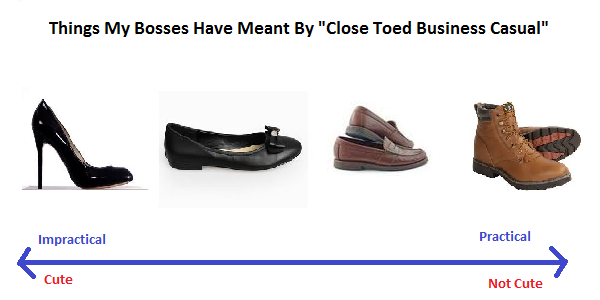
On the other hand, female engineers have the dreaded moment when they look at their dress code and see a simple requirement to wear “closed toed shoes”. My past HR departments argue that this allows for freedom, but I’ve found that it really means that women are expected to wear any one (but not all) of the following shoes:
     
As you can tell,  there is a direct linear relationship between how practical the shoe is and how likely you are to be mistaken for a lesbian. But technically, all of these options are “close toed”. And if you are a woman in engineering, then you probably thrive on technicalities.

I made the “close toed” argument once when I was trying to pass off a pair of flats as close toed at a last minute client site meeting (which had worked countless times in the past). My boss had not told me that there were any additional protective clothing requirements, so I hadn’t brought anything special. My client pointed out that while my shoes were close toed, they were open footed- and therefore were not “close toed” per his definition.

I didn’t have any other options, so he pulled his extra pair of smelly, beat to hell, size 13 work boots out of the bottom drawer in his filing cabinet and slid them across the table to me. I, of course, was not wearing socks and I wasn’t about to put this 20 year old rank pair of boots on barefoot. So I wore the boots on top of my flats, and tied the laces around my legs like ballet slippers to try and secure the shoes while I took measurements. It turns out that it is even harder to walk in two pairs of shoes with varying sizes than it is to walk in heels. My clients have teased me about this ever since, with several clients offering me the shoes off of their feet before we go to work.

After this embarrassing mishap, I am happy to report I invested in a pair of steel toed boots, and developed a simple solution that seems to define what shoes you should be wearing: for presentations, I suck it up and wear heels; for computer work or work confined to a cube, I wear flats; for work involving dangerous chemicals, I wear “women’s loafers”; and for work involving heavy machinery I wear steel toed boots. There you go every HR department for every company I’ve ever worked for, was that so hard?

Love,

Vanessa