Showing posts with label respect. Show all posts

Monday, August 18, 2014

How To Make Yourself Heard

My first week at my new job, my supervisor asked me if I could quickly come to a meeting with him. I had no idea what the meeting was, but I swept my notebook off my desk and followed him through the maze of hallways to a conference room. Once I crossed threshold into the war room and noticed the sea of leather notebooks and iPads I realized that these were not fellow engineers. In fact, it was a meeting of supervisors, managers, and directors. But since I was totally new and hadn't met any of them yet, I could only tell that they were important.

WHAT AM I DOING HERE? I panicked. At my last job, my supervisor always briefed me days in advance if I was going to meet anyone important so I had time to prepare my presentation and not look like a total nincompoop. Given at the time I thought his briefings were totally unnecessary, but finding myself in some mystery meeting I began to wish I knew anything about what I should expect.

My supervisor motioned to a plush leather chair next to him, and I nervously sat down. A commanding middle aged man walked into the room, and the other men all fell completely silent. They began to discuss business, training of new engineers, who had been fired, and the path they wanted to take to success. On one hand I was excited to get to hear this information first hand, on the other hand I felt like I was peeking behind the curtain and I would be in trouble if anyone noticed me there. Maybe if I just leaned back a little I could disappear. Or maybe that would make me look lazy. Maybe I should be taking notes. But since none of these were action items for me I might look like a secretary.


And then, all of a sudden, the commanding man turned to me, "And what about you? Do you have anything to add? I'm sorry, I don't think I've met you yet..."

"Vanessa," I choked out.

"She's a new engineer here," my supervisor said.

"Well, Vanessa, do you have anything to add?"

Was I supposed to have something to add? What do people normally say? Am I missing some social cues here?


"Um, no," I smiled weakly, hoping the pathetic smile would help lessen the blow if I was expected to have some ground breaking answer.

"Okay," he said, moving onto the next subject.

It was the first time in ages I'd been afraid to speak up during a meeting, and I was ashamed of myself. I'm not a shy person by nature, but I was so distracted by mitigating the consequences of saying something off point that I ended up saying nothing. And when I say nothing (especially when asked) people presume that I have nothing to say, effectively causing the same problem if I had said something idiotic.

I wish this was just a personal problem, but research shows that in collaborative environments women spoke less than 75% of the time of their male counterparts. So apparently, I'm not the only one with a propensity for psyching myself out in a meeting.

Feeling like my voice had been stolen by a sea witch who had given me the chance to be a real engineer for a day was something I was familiar with from my intern days, but was a habit I kicked when I really listened to what other people were saying. They were not more qualified to speak than me, and my conclusions were no less valid that theirs. As an engineer, I am paid for my ability to solve problems. If I just sit in a room like a bump on a log while I let others solve the problem, I am not really doing my job.

If you don't get this reference, you got some Disney to watch.
So, I started speaking up in meetings. The first couple times it came out sounding more like an apologetic question than actual feedback. But eventually I became a regular participant in meetings- unabashedly sharing my knowledge and even disagreeing with other people when I felt otherwise. This isn't a business where they pass around a sharing stick to make sure everyone feels included, so if I had something to say I made sure to interject it. That didn't mean that I would chat through the entire meeting and make unfounded statements. Just that I was no longer afraid to act like people should respect my opinions. The world didn't implode, and once I learned how to speak in statements instead of questions people took my input seriously.

After years of practice it was second nature, which is what made the most recent case of meeting jitters so strange. Luckily it seems like it was a result of me not knowing what to expect and I've already gotten it back under control.

Have you ever had a tough time speaking up during meetings? How did you convince yourself to speak up?

Love,

Vanessa

PS. If you like what we write be sure to subscribe, share this post, and leave a comment below!

Monday, September 9, 2013

How to Spot a Good Manager

Vanessa tells me that while I talk a lot about what it's like to be a new engineer in the field, I don't talk frequently about what it's like to be a female engineer. I don't talk a lot about gender roles in engineering because I don't feel I have as much to contribute on the topic as most other women in engineering. This is because I work at an engineering company which has close to 50% women, which is is kind of like stumbling into cave full of already-mined, already-cut 30 carat diamonds after stumbling through a cave of already-mined gold. I know that you're thinking, "liar, liar, pants on fire! No engineering company has that many women!" But it's true.

This is how I imagine we would interact if/when I mentioned the gender distribution at my firm in a face-to-face conversation.

And there is more. Not only do I work with a decent number of female coworkers, but there are also a fair number of women who are managers at the company. Yes, my boss is a woman. To top that, my boss' boss is a woman and my boss' boss' boss is a woman.

So, you see, I'm not the most informed source when it comes to engineer workplace gender inequalities. I do, however, have a bit more insight into women in management. I compiled a list of the women in management, categorized them into good managers and poor managers, and compiled a list of common traits for each category. This list is solely based on female managers, but looking back at it, it's clear that it's applicable to both genders. Anyways, onto the list.

In my opinion, there are a few things that good managers will do:

Maintain realistic expectations
For me, what truly makes a manager stand out is that they are realistic and that they maintain focus. They know that ideals are great, and can be pursued to a certain extent, but you must keep your eye on the prize at all times. These managers accomplish a great balance between encouraging scientific inquiry and requiring deliverables which will meet business needs. They allow time for your pet projects (e.g. investigating a really weird observation, which could result in a new discovery and published paper), but also keep the main focus on the business needs (e.g. that equipment redesign plan that's necessary to for the next phase of the project).

Give praise when praise is due
Another common theme with some of my awesome female managers is that they know when and where to give praise. An ideal manager will give praise regularly for big-ticket projects and occasionally for doing a good job in general. Praise should be given regularly, but not too frequently.

Poor managers have a hard time balancing the correct amount of praise. Some will praise you too frequently, which doesn't seem like such a horror until you realize that they're praising you for things that don't merit praise (e.g. taking meeting minutes). Then, when they do praise you for big-ticket projects, it no longer feels like an accomplishment because your epic three-week intense project got the same response as taking meeting minutes.

Other poor managers will praise you too infrequently. In these cases, the managers don't appreciate your work, nor your many unpaid overtime hours, nor having a project be well-received by a client, nor that you saved their files from an untimely coffee spill. All of these acts are worthy of praise, especially that last one, of course. The bosses who cannot see that such acts are worthy of praise can pretty much be described in one word: "grumpy." I've seen first-hand how a lack of such praise makes employees feel defeated and thus think that overachieving will never be worth the effort.

And here are some things that a good manager will not do:

Disrespect the underlings
I had one manager who told me to my face that she knew more about science than I did, even though her degree was in business management. Telling anyone that their knowledge is inadequate when they've worked and studied hard in the area is going to hurt them. Plus the underling will know the manager is full of crap and lose respect for the things they do know about.

Be a slimy politician
Seriously. Reserve politics for the actual politicians, the ones who think they run a country and who like to talk circles around the issue. If your manager thinks she's a smooth talker, then I can almost guarantee that her underlings think she's a lousy scientist and a panderer. That manager tends to make life harder for their underlings. Because let's face it, smooth talkers make impossible promises. And then the underlings either have to bust their butts to meet unreasonable deadlines or deal with falling short when the deadline arrives.

Do not be indecisive and inconsistent
That one's pretty much self explanatory. Good managers aren't wishy-washy. Good managers don't change their minds (unless it's justified by new evidence). And good managers have their thoughts organized enough that they remember what they've previously decided. It's a waste of time to convince someone of something you've already spent an hour convincing them of earlier that week.


If you look at the list, you'll realize that there's no reason the same exact list can't apply to men. I have never seen any particular drawback which is specific to one gender or the other. In my mind, if you're a good manager, then that's the end of it; management skills aren't attributable to gender. The female managers I have dealt with aren't catty, bitchy, or any of the other stereotypes engineers often think define a women in management.

However, I do acknowledge that all of these cases of good and bad managers came from my own experiences with women in management and that my data may have a systemic bias/skew because of the distribution of women/men in my firm. So I'd love to hear from other sources: What is your company's gender distribution like and what are your experiences with women in management?

Best,
Ruby

Monday, August 19, 2013

How To Be An Engineer, Not A Secretary

I took minutes for a few meetings this past week and sent them out to everyone in attendance. Each time, my boss hit the reply all button and commented with a simple and quick, "Great minutes, Ruby. Thanks for doing this." I am fully aware that I respond well to praise and validation, so this little comment from my boss is a nice touch. However, the number of thanks I've got for taking meeting minutes is disproportionate to the number of thanks I've gotten for doing other things, such as my daily engineering tasks. This makes me wonder, I am perceived as a better secretary than an engineer?

I know I'm good at secretarial things, like taking epic meeting minutes. As an engineer, I find it easy to accomplish and integrate them into my daily tasks. After all, I'm the technology-savvy one of the group. I can essentially type at the pace that people talk and capture all the important pieces of conversation while simultaneous pulling up schematics and study designs and contributing to the meeting. I can also manage to reorganize my notes so that it's more cohesive and understandable than the actual meetings.

I choose to complete some secretarial tasks to improve my own job performance as an engineer. But just because I'm good at secretarial tasks shouldn't mean that I should be relegated to a secretarial role in my boss' or coworkers' minds.

In fact, I find that more people (and my boss in particular) are aware of and impressed by my secretarial skills than my engineering skills. This is a little surprising. I know that my technical background can be impressive. After all, one of my coworkers told me I'm one of only two young employees he respects technically. I've also been given the nickname of "genius" (which is really awkward when said in hearing range of any of my other coworkers). Given my experience, accomplishments, and expertise in technical work, it's weird to get compliments on non-engineering work rather on work that takes a lot more skill and expertise.

My question here is: Why is it that I'm more recognized for being secretarial than technical?

I can imagine a number of explanations including gender role prejudices, a subconscious drive on my part to be a secretary, it's a knee-jerk reaction/compliment, or just because I'm the newest kid on the block.

Maybe the reason for my receiving praise for secretarial work can be attributed to gender role prejudices. I know there's a study which indicates that generally women in the group are relegated to "female" jobs such as being the secretary.
Women who have internships or jobs, she [Susan Sibley] explains, find they"are too often relegated to 'female' roles of note-taker, organizer or manager." ~Study by Susan Silbey at MIT 
In Susan Sibley's scenario, the female engineer is in the minority and therefore her coworkers will consider her the only option to fill the role of the (female) secretary. My problem is that this scenario isn't really applicable to my own situation. In my workplace and especially in the aforementioned recent meetings, I have been surrounded by what might be considered an abundance of women. Anything ratio of women:men which exceeds 1:1 is unusually high in the engineering industry. And most of the women I work with are intelligent and diligent scientists and engineers. However, I seem to be the only woman amongh this crowd who takes on the role of secretary.

It could be that thanking me for secretarial work is just a knee-jerk reaction on my coworkers' part. It could be that it's a habit to compliment someone for doing something outside of the scope of their everyday job in the same way it is a habit for you to always respond to, "How are you doing?" with a simple "good" or "fine." It's possible that my coworkers would give the same compliment regardless of who did the actual minute-taking. In this scenario, they aren't necessarily pointing out that I was doing secretarial work, but just that they appreciate it was done.

Perhaps, as I mentioned earlier, this whole situation has arisen because I have the unconscious mentality that I should be a secretary. I personally don't think of my note-taking and organizational abilities as my subconscious trying to make me into the obedient little secretary it always wanted me to be. That would be a seriously weird and devious move on my subconscious' part. Rather, I think of my actions as a means to obtaining the best notes possible and not being able to trust someone else to do it as well as I can. Because seriously, no one takes better notes than I do. And if getting the best notes possible is the goal, then taking them myself is the practical solution. (Mindset of a control-freak engineer, right here.)

I guess what I'm trying to say is that it's hard not being recognized for your braininess. It's hard to be recognized for your simple, mundane (though necessary work) when what you really want is to be recognized for the big things that I accomplish.

You want to be called first and foremost an engineer because you put in your time at school, you went through the pain of all-nighters, you learned those complex formulas and processes, and you earned your engineering degree. But you're not done yet. You have some more time, pain, and learning to go before you'll be universally recognized as a engineer.

Monday, July 15, 2013

How to Handle Your New IT Role As An Engineer


So I got through four years at college, graduated with an impressive engineering degree, and entered the “real world” by getting my first job at an engineering firm. What’s the first thing I noticed? It wasn’t a personalized nameplate in my own, brand new office, that’s for sure.


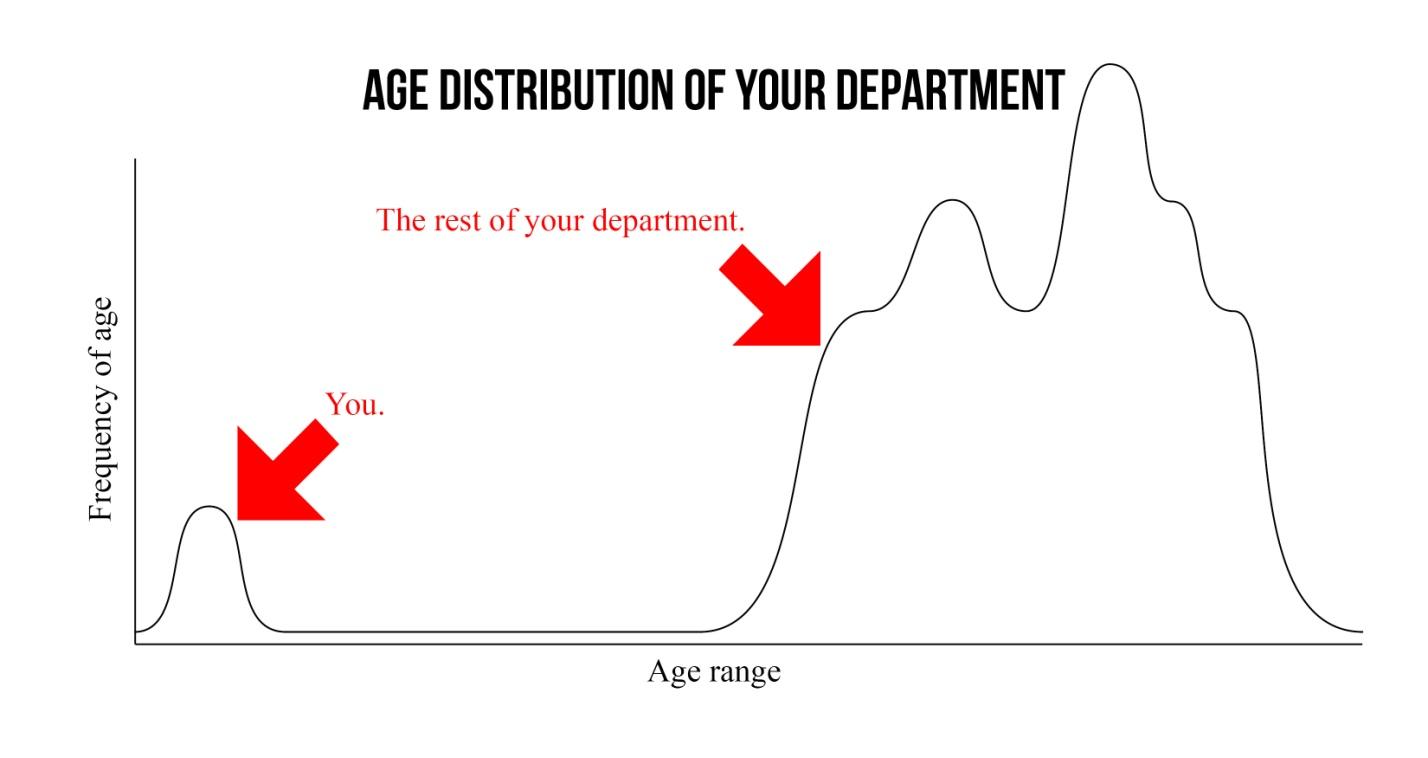
The first “I’m not in college any more” moment I had was when I walked into work and notice how old the rest of my office mates were.


I don’t care how mature you are or if your only friends were professors and grad students. I, too, have always hung out with people who were about one generation ahead of me, so I can assure you that I am used to some pretty wide age gaps. However, the difference in ages between my peers and me is immense. I lowered the average age of my department by ~5 years just by joining.


When you find yourself in this predicament, prepare yourself for being called the “baby” and for awkward conversations about how your coworkers’ kids (who happen to be your age) are also graduating college. But the biggest obstacle you will be faced with is the responsibility of teaching your coworkers everything about technology. And you will realize how much you take your knowledge of technology for granted when you have to teach someone:
  • How to copy and paste
  • How to crop a photo
  • How to filter junk mail
  • How to do other mundane, simple tasks

Your gut reaction will be to judge these people for their noob-ism because they are definitely judgment worthy. If you are able, you should quietly accept your job as the new IT person in the office. I, for instance, am now the go-to printer fixer in my office. Whenever a printer issue arises, my office mates call their new hire, Ruby, to save the day. And I readily drop my own projects to deal with the issue at hand, because what else can I say when my limited computer experience will gain me fame and glory in the eyes of my peers. However, the time I spend helping my coworkers fix paper jams and changing the toner is time not spent on my real, engineering projects. If you are like me, you may start to resent the naivety of your coworkers when it comes to simple technology issues.

After a period of time, however, you will be able to look past the computer-idiocy of some of your peers. Some of them have real intelligence and practical skills that are applicable and actually quite helpful to the job at hand. Granted, it will take you varied lengths of time to find this knowledge or skills in your peers. Some of them may hide their skills/knowledge for longer than their own lifespan. But with others, you will discover this fascinating, hidden facet of their professional life in just a few weeks.

So the next time you feel like sweeping everything off your desk in a dramatic gesture of exasperation because you were asked how to take a screenshot, just remember that someday your coworkers will impress you.

Best of luck,
Ruby

Monday, July 1, 2013

How To Not Become A Flasher

There are some days when you leave your home thinking you’re going to have a normal day of meetings and sitting in your office, working at your computer. On those days, you might think it a good idea to deviate from your usual fashion of practical business casual wear. On those days, you might think it a good idea to finally wear that flowy skirt or new dress. After all, even though you work as an engineer and frequently disregard your girlish impulses in order to fit in, you are a girl and it is socially acceptable to wear skirts and dresses once in a while. If you are like me, you will be thinking, ‘What could it hurt to wear a dress on such a drab work day?’ 

Let this be a warning from personal experience: Disregarding your better (more practical) judgment to satisfy your girlish needs is not a good idea. Inevitably, the day you choose to wear a dress is the day you will be faced with some emergency which requires you to take apart and reassemble a malfunctioning piece of equipment, visit a client site which requires that you wear a pair of gross/moldy coveralls over your clothes, or even climb through air conditioning ducts superspy-style to end a dangerous hostage situation. 

In all of these cases, your girlish impulse to wear a dress is a hindrance. If your job is anything like mine, you have a 100% chance of flashing your coworkers while reassembling that mischievously malfunctioning piece of equipment. And if you attempt to do your job while consciously trying to avoid flashing your coworkers, you’re going to do it awkwardly and inefficiently. This is one of my greatest examples of a lose-lose situation. Either you are subject to embarrassment in front of your coworkers or your reputation takes a blow because of your inefficiency, all because you decided to wear a dress. 

After having experienced this first-hand, I have defined a new rule for choosing my work attire: Do not wear dresses. Do not try to try to make a fashion statement. Do not try to overthrow the suppression that your workplace practicality has imposed. This is one of those moments where it is a good idea to suck it up and bear it. 

I now intend to put a sign on my closet which reads something like this:

"Oh you want to wear a dress? No you don't. Put it back and grab those pants. Flashing is reserved for sex offenders and camera bulbs.

And if you’re having a hard time choosing what to wear, my friend Vanessa has kindly already provided some advice on what footwear is appropriate in the workplace. 

Now, avoiding wearing girly clothing just because of some hypothetical, superlative situations may sound suppressive or even discriminatory against women. I, however, don’t consider my advice anti-women or anti-feminism. In fact, I consider this choice in attire to be helpful to gaining women respect and rights. 

The reality is that I’m an engineer AND a feminist, which means I tend to go about obtaining respect for women in a practical manner. In my mind, women shouldn’t demand respect just because they are women. They need to earn respect by doing respectable things. Flashing my coworkers in a 100% avoidable situation doesn’t gain me respect; it actually discredits me. My coworkers will think of me as that girl that tries to do a man’s job instead of as just a coworker doing an engineer’s job.

Alternatively, if I dress appropriately for the job, as a typical engineer would (in practical, reasonable attire because we engineers are practical people), then I will hopefully be thought of as an engineer first. My reputation won’t be degraded, I won’t be embarrassed, and I’ll still be on par with all my other coworkers. Being thought of as an engineer who happens to also be a woman shifts the paradigm toward people understanding that everyone is capable of being an engineer regardless of gender. 

After all, women deserve respect in the workplace, and I simply can’t get that if I’m flashing everyone. Plus, by going about this reasonably, I’m able to combat the notion that women are unfathomable, illogical, and flighty creatures.

I, at least, will be removing skirts and dresses from my work attire from now on.

Monday, June 17, 2013

How to Not be an Anti-Feminist

DISCLAIMER: I realize this post is lacking my normal humor, but some issues need to be addressed more seriously.

As a professional female engineer I am constantly fighting stereotypes.  Some people see  me and think I'm a secretary. Some people assume I'm dumb and just got the job because I'm a woman.  Some people assume my gender precludes me from certain types of work. While it's weirdly fulfilling to shock people with my ninja engineering skills,  it definitely can wear on me.

The easy solution is to blame these associations on the men that dominate the profession,. But the truth is  some of the biggest opposition in making engineering a normal job for women is actually other women.

In engineering,  I've come across a spectrum of women:

Note that this is a spectrum, and that not all women fall into a single category

On one extreme is the ultra feminist who constantly points out oppression.  She asks that women not be forgotten, and constantly reminds people of the gender divide.

In the middle is the woman who counts herself as equal to (not better than) male counterparts. When at work her focus is her job, not her gender.

On the other extreme is the woman who was forced into engineering and is waiting to get married. She asks that men continue to treat her as a "lady".

All three groups arguably have their issues, which I can discuss in a future post. But some members of group 3 voice their lack of passion for engineering in such a way that they reinforce damaging stereotypes -  holding the rest of women back. It is this group which I think can have the same impact as a misogynistic man, and which I believe warrants further discussion.

For example there is the case of Jane, a Type 3 engineer.  Jane is a 3rd generation engineer,  and a nth generation aspiring housewife. Whenever Jane gets work she doesn't want to have to do, she denies it because it is not "women's work" and would be shameful to undertake. Things that are not "women's work"  include : driving,  making large decisions rationally, and anything else she doesn't feel like doing that day. She also frequently asks if her clients will be young eligible bachelors when she is assigned a project. I wish I was joking.

The problem with this is not only that she is destroying her own reputation, but that the men who have worked with her for years come to actually believe that there is such a thing as "women's work"  and hesitate assigning projects to other women. Several men have voiced concern when assigning me complex tasks, since Jane had previously complained that it was "man's work". In my mind,  this is the single most damaging thing to the inclusion of women in the workplace -  because while men can be punished for expressing that women are unable to complete tasks as a result of their gender,  women are less likely to be chastised for the same behavior. And, generalizations are more likely to be considered true when they are endorsed by a member of that group.

While I understand that behavior in Jane and others like her is not necessarily driven by a hatred of other women, I believe it is driven by an appalling lack of respect for the capabilities of women. The damage that this behavior causes, and the number of women who can be negatively impacted by the actions of just one other woman is staggering.

In order to prevent this damage, we each do two simple things to help change the world's perception of female engineers:

1) Attribute your own likes and dislikes and strengths and weaknesses to yourself instead of your gender.  We are all individuals and have different tastes and interests.

2) Encourage women to pursue a career they are passionate about (not necessarily just engineering).  There is a thin line between encouraging someone to consider a different field and forcing her to join a career which does not interest her.

Each one of us has the power to impact how society views female professionals, so if we all take simple measures we can make the lives of other women just a little bit easier.

Love,

Vanessa