Showing posts with label female engineer. Show all posts

Monday, February 23, 2015

Age != Experience

(Or Age Does Not Equal Experience, for those of you who aren't familiar with regex notation)


Ever since I was a child, I always felt like I was underestimated because of my age. I was lucky enough to have parents who treated me as an adult and took my ideas and opinions seriously even before I had graduated from Velcro sneakers or learned to correctly pronounce the word "vanilla". And yet, I quickly began to realize that other adults would completely discredit whatever children said based on the fact that we were, in fact, just children. I looked forward to the day I was 18 and  people would magically begin to listen to what I had to say without following it up with a "Did you hear what Vanessa said? That's so cute." 

My first engineering job was actually in high school, because I found another person who had faith in my work even though I had barely just gotten my driver's license. I had my own project, my own goals, and my own equipment, without the coffee-getting and copy-making that is normally associated with a high school job. My boss taught me how to dress, speak, and act like a professional instead of some ditsy teenage girl, and as people heard what I had to say, I noticed they slowly began to listen. The more people saw the work I produced, the more they ignored the fact that I had to go back to high school on Monday morning. To be honest, in the years I spent there I did more real "engineering" than I did subsequently.

I think this is what other people saw when I walked in the room
My 18th birthday came and went, and noticed that the bar for being taken seriously had moved up a few years. As I stacked on more accolades and years of experience, I got used to the fact that people would always either be surprised about my age (if they had seen my resume first), or not believe my experience (if they had seen me first). Eventually, I learned these two opposing perceptions of me would come to equilibrium because I worked hard and I earned people's respect when they saw what I could accomplish. But after almost a decade of having to constantly prove myself to doubters, I always thought there would be a time where I don't have to spend my first six months proving that I have some baseline competence. 

Fast forward to today, where I am well into my twenties, and in a required training class with other new hire engineers. I'm almost a decade younger than the next youngest person in the class, but have the second most years of experience in the industry.

One of the oldest men made a blanket statement of, "Yeah there are a lot of people here with very little experience before they got hired, like Vanessa." I turned to look at him, questioningly. "Well, this is your first job out of college, right?" he continued. 

"No..." I responded, a bit annoyed since we had introduced ourselves with our previous experience earlier that day. He either had the world's worst memory or was choosing to disregard what I had said. 

"Well, I mean you just came from that other thing, but it was just a co-op position."

"No, it was a job."

"Oh, so like an internship?" he smiled, as if he had caught me in a lie. 

"No, it was a job."

"But this is like, your first engineering job, right?"

"Nope, and it's not my second engineering job either..." My computer pinged, and one of the other guys in my class had just walked into the room and had IM-ed me 'Vanessa, be nice'. He's right, don't let this guy make you act unprofessionally, I told myself. 

"But you didn't do actual engineering before now, right?"

"I have been actually engineering things for almost ten years now," I said, being careful to control my tone so I didn't show my annoyance. 

"Well, okay then," he chuckled, turning away, and starting into some new conversation. 

While this particular experience is clear in my mind due to its recent occurrence, it's anything but rare and yet I'm still never sure how I should respond. Should I keep copies of my resume stamped by a notary? Should I have them Google me so they know I'm not full of shit? Should I just laugh it off and let them think that I'm an incompetent young fool who was accidentally given a job she didn't earn?

I know that my other young female overachiever friends often report similar experiences to me. And, while I presume some young male overachievers experience the same thing, I've never witnessed it, and my friends have not admitted such experiences to me. As a result, I'm unsure how much of this has to do with being young, and how much has to do with being a young woman. But either way, I don't see a clear way to tackle this systemic issue more than one experience at a time, except by rising above it myself. 

In a lot of ways, it's these experiences that drive me to be the exception to the rule, like my first boss. To listen to what people have to say regardless of whether they are 5 or 30 or 63 or 92. To judge people based on their potential and their accomplishments. To take everyone seriously from the moment you meet them, and base your opinions on facts and not assumptions. If we can each try to do these things ourselves, then perhaps it will start to dwindle as a problem overall.

Love, 

Vanessa

Monday, November 3, 2014

How To Survive Making a Mistake

On this blog we've mentioned awesome performance reviews, bosses complimenting your hard work, and management admitting how much of an asset you are. And yes, we've gotten a lot of positive feedback on our work over the years. But, everyone makes mistakes and I am no exception.

The truth is that making a mistake in the engineering world can be extremely terrifying. In many engineering positions, you are directly responsible for the safety of people. Think airplanes, cars, boats, water filtration plants, and so many other systems. An engineering error in these systems could prove fatal. Even when you aren't responsible for life safety, a mistake could cause millions of dollars of damage to the company. And while engineering organizations have many safeguards in place to make sure their systems are safe, engineers themselves are still human and can make errors. 

As a new engineer, sometimes it's you that causes the error. Usually because no matter how smart you are, you may not know enough about the nitty-gritty details of your new profession to know that you are making a mistake. That's exactly what happened to me once at my last job. 

It was a typical day at work, and my phone rang. 

"This is Vanessa," I said, as I continued typing. 

"Vanessa, this is bad," said a man on the other end, a client from a project that was being installed. 

I stopped typing, and paused for a moment. "What?"


"Did you tell somebody to install this [very standard part you've used in every other design with no problems]?" 

"Yes... Why?" my heart started to beat quickly. 

"Why the fuck did you do that! It's completely wrong. You better pray it works and start polishing up your resume, because if it doesn't work both of us will be out of a job.You know if you screw this up you'll have costed us [unimaginable amounts of money]. Really Vanessa, what were you thinking? I've got to try to clean up this mess." 

He slammed the phone. Stunned, I slowly lowered the phone down into it's cradle. I silently stood up, walked to the bathroom, and immediately vomited. It wasn't intentional, I just was honestly so stunned and terrified, I literally got sick. And then I sat on the bathroom floor (gross, I know) my mind was abuzz. I normally take feedback very well, but thinking that I was the root of a problem this big was causing me to completely unravel. 

How could I have known? College didn't teach me the mundane details about industrial equipment, and nobody had ever suggested that there was a problem. It was such a standard and seemingly insignificant part of the system, I never doubted it would work.  How was I so stupid? If this isn't right, what else is wrong? If I didn't know this basic fact, how many other mistakes did I make in the design? Should I even be an engineer? Maybe I should just give up and do something else. I can write. I should be a writer, then I won't cost companies millions of dollars and ruin peoples careers.  

I wanted to hide, to disappear. I started wondering if I could just leave work, and never come back without having to confront the problem. I was ashamed and incredibly scared of what might happen. 

There, sitting on the office bathroom floor like a complete nut job, I texted a good friend (who isn't an engineer) and told her I was freaking out. She managed to talk me out of my downward spiral, and helped me realize that hiding in the bathroom wouldn't insulate me from my mistake. 

So I sucked it up, went back to my cubicle, and began to research the problem. Within 24 hours, I'd found a way to use the same part in a different way in order to solve the problem. Yes, I may have made a mistake, thrown up at work, tried to hide in the office bathroom, and cried myself to sleep. But in the end, I solved the problem and learned something to help me in the future. Long term, the the part I was most ashamed of was my reaction to the mistake and not the mistake itself. 

I realized from this experience (and others that followed) that some of my clients had a little bit of a flare for the dramatic.Who can blame them? They are all under an immense amount of pressure. and until we had a solution everyone was in the same mistake purgatory. But I've realized that spending time fretting about an error doesn't get me any closer to the solution (even if everyone else is freaking out). So instead, I've changed and adopted a much more level headed approach to dealing with mistakes.

Treat every mistake the same way. Understand the consequences, but treat it like a problem in school. This allows you to gain emotional distance and approach the situation with a clear head.

Assigning blame is a waste of time.  Whether it was the fault of someone you hardly know, your arch nemesis, or even your own fault, assigning blame just makes people nervous and makes it less likely that you'll get relevant information about the problem at hand. That said, do not accept blame for something you did not do. A lot of people react poorly in the wake of an error, and you should not volunteer yourself to be a scapegoat. 

Use your engineering training. I started typing steps for how to identify and solve problems, but as an engineer you already know this.

Ask for help, and fail loudly. If you don't have the tools to succeed, ask for help. Nobody can do everything, and it's better to let management have the chance to step in and help (especially if it is an issue related to safety) than to hide the problem until it's too late to fix.

Hopefully, these tips will help you find your way to the light at the end of the tunnel after a mistake.

Love,

Vanessa

Monday, August 11, 2014

How to Apply to Jobs Without Being Fired

At many companies, there are cultures of happiness, creation, and productivity. At certain companies, there are cultures of depression. At some point in time, people at the latter set of companies begin to discuss with their coworkers their plans for their future- which do not include the current company.

So obviously talking at your current job about quitting and moving on to greener pastures is super inappropriate, especially when nobody in the conversation actually has another job yet. If you are truly unhappy you should just confide in your close friends, right? It's a weird line that adults don't warn you about when you are in school. Once you join the working world and spend 8+ hours a day with the same cast of characters, a lot of your friends are people with whom you work.

Enter one of my coworkers (and friends) who made a habit of walking over to my desk to loudly talk about the job applications he had filed over the weekend. He'd asked me to review his resume outside of work, and always texted me when he came across a job he thought I'd like. But during the work day I sat close to our supervisor's office, so I'd hush him at remind him we were at the office and not at a bar.


"I don't care. I want them to hear," he'd say in a huff. "Maybe then they'll fire me. That would be the best day of my life."

For those of us who don't want to be fired but are looking for a new career, here are some simple ground rules.

Don't look at job sites while you are at work. I know when you are unhappy or bored it can be extremely tempting to pick up your phone and check your Monster app, write scathing Glass Door reviews,  or search "anything better than this" on Google. But if somebody sees you doing this at work or notices your browser history shows you spend hours each day doing something that is not your job, this could turn out very poorly for you. Most companies have policies about internet usage (and that usually includes what you browse on your personal phone while on company time). Don't let an unprofessional environment make you an unprofessional person.


Don't talk about your job applications at work. Even if somebody else comes up to discuss his or her future plans (which is behavior you should kindly discourage), you should not respond with information about your search in return while you are in the office. You should probably not discuss this with coworkers at all, since juicy office gossip has a tendency to spread like wildfire. But if you feel like you have to tell your best friend that you have an interview, do it after work when you are not on company property.


Continue to do your best work. This can be very difficult when you are distracted dreaming of new possibilities, but don't let the theory of a new life get in the way of the job you have right in front of you. We live in a world that is continuously getting smaller with the advent of better transportation and more accessible communication devices, so a bad reputation in your current job may carry over into your future life.


Take interviews sparingly. Before you decide to leave work for an interview, make sure you are actually interested in the potential job. Ask questions if you are unclear about the opportunity and be honest with yourself. Is it a good job or just not the terrible job you feel you have right now? Many opportunities will be available to you, but you don't want to have a poor attendance record if you already know you aren't interested in the potential job.


Minimize dishonest behavior. When you have an interview half way across the country on a Wednesday, it's kind of hard to figure out what to tell your boss on your "vacation request" form. My advice is to not say anything unless directly asked, and to tell the truth (minus the interview portion) as much as possible. Don't use anything that requires others sympathy as an excuse (such as "my grandfather died", "my son is ill", or "my roommate is in the hospital"). If everything works out, they'll figure out later that you were at an interview when you accept the new position and you don't want to look like an asshole. If you decide not to take the job, you don't want the story to be interesting enough to bring up questions.


With this advice, you can find a new job without compromising yourself as an employee. By keeping your conscience clean, you can take your time looking for new work and find the perfect next step in your career.

Love,

Vanessa

PS. Have you ever ended up in a sticky situation while applying for jobs? Let me know in the comments!

Monday, May 19, 2014

How To Deal With Work Exams

I remember the feeling of relief after I took my last final senior year. I remember going out with friends and celebrating taking our "last exams ever".  I remember being ecstatic that I'd never have to study, cram, and stress over a graded assignment. Looking back I don't know how this rumor of the "last exam ever" is accepted as fact by the majority of graduating engineering students, when many of them will have to start taking qualifying exams for work just a few weeks later.

If only there were such a thing, it would probably be awesome
Sorry engineering students who think they will never be tested again, but I've taken countless classes, quizzes, and exams since graduating college.

In fact, just a few weeks ago, my manager beckoned me to his office. I don't know why but I still have a principal's office syndrome about being called into managers' offices; I am always convinced I'm in trouble even though I know I'm a top performing employee. He told me I'd be taking an exam  for a professional certification in two weeks, and that I should get the study guide today.

Paging through the 1400 page study guide, I realized that I knew practically nothing about the subject. I looked up exam reviews online, and all the recommendations said I should take six months to study. And I had just two weeks to learn it all while still making all of my project deadlines (because my clients don't care that I'm taking some exam that isn't related to their system). Cue me freaking out.


It was like finals week all over, except this time if I failed, I wasn't the only one to pay the price- my company would suffer too because they wouldn't be able to use my certification. I studied every minute I had available the first week: lunches, weekends, after work, flashcards when I got up. The second week my work signed me up for a cram course and we ate, slept, and breathed the course material. During breaks I delegated project pieces to people in my home office, returned client emails, and tried to network with the other students (who worked for a range of potential clients).

And at the end of all of this, was a day long exam. My boss drove me to the test,  and all I could think about was how awkward the drive home would be if I failed. The test itself was a whirlwind (as most tests are)  and the entire day disappeared in what seemed to be a matter of minutes. As I clicked the submit button, I winced.  I was sure I was in for the most uncomfortable hour long car ride of my life. The proctor walked over to my station,  his feet thumping slowly in rhythm with the frantic clicking of test takers.  He handed me a single piece of paper and my stomach dropped.

"Why do you look so sad?" he asked.

"Honestly? I just don't think this went very well," I sighed.

He gave me a confused look and pointed at a line mid-way through the page he'd given me which read: "VANESSA POCKET has passed" in bold letters. A wave of relief washed over me.


In reality, the worst part of exam was the pressure I put on myself. And while a certain amount of pressure helps drive me to success, I had to try to leave out any thought of self doubt while I studied in order to allow myself to learn. If you take a moment to breath and quiet the critical voices in your mind, you can get back into the studying grove that let you get your engineering degree in the first place.

So work exams may exist, and they can be hard and stressful, but they are also a chance to prove your engineering prowess. In an industry where others sometimes presume your gender is the reason for your success, it can be a blessing to have hard results that show your skills. So think of life with exams as a positive thing, and go forth and own them!

Love,

Vanessa


Sunday, October 27, 2013

Why Most Engineers Don't Have Blogs

Because when push comes to shove 40 hour weeks can only account for the time I spent at work Monday to Wednesday,  weekends are but mere suggestions,  and I occasionally spend 12 hour days just arguing with people twice my age to ensure that my system works properly. Since I am passionate about my work and have what I believe to be a strong moral compass,  being confronted with individuals who are blowing smoke up my ass day in and day out so they can make a quick buck is extremely disenchanting. I think perhaps it is right of passage to adulthood to have the pleasure of a grown man looking you in the eye and lying about something that matters. And I think it is a right of passage to becoming a responsible adult to learn when and how to tell people you fucked up.

As much as I have ideas brewing,  and opinions I want to share,  I have to admit that in weeks like these I just come home and collapse in my bed,  and only get up in time to go to work again (in less than 7 hours).

At the same time,  I hate and love every moment. Every time I find out somebody has screwed me over,  I also know that I've caught a mistake before it causes damage. And I know every moment that I need to stay up,  every person I need to yell at,  every person I have to take yelling at me,  I know it's all worth it. And I don't want to risk loosing the ability to catch those errors.

And that is why I think most other serious engineers tend to stay away from blogging. Not because we can't write,  nor because we don't have opinions. Writing in a public forum is a risk,  and one with outcomes that cannot be accurately calculated. It's exactly what we are trained to avoid. And the risk of getting caught couldn't be higher; our dream of being able to continue to create is at stake.

Yet I still am writing. Maybe because I'm crazy,  maybe because I think it's important that people know that engineering is more than sitting on your butt and collecting a big pay check,  and maybe it is because I believe that discussing issues that plague our industry is the only way to fix it. But either way,  I'm going to keep on blogging and making crappy stick figures (at least for the near future).

Love,

Vanessa

PS Why do you think we don't have more active engineering blogging community?

Monday, October 21, 2013

How to Pick A Cute Work Hairstyle

I apologize that I missed last Monday's post. I'm going to try post two times this week to make up for it (insert gasps and cheers from all 20 people that read this blog regularly and never comment). This week I decided to go with a less substantial topic that still impacts engineers: hairstyles.

In an all male environment, it's hard to find inspiration for ways to spice up boring hair days. Something about wearing your hair completely down and having it look nice by the end of the day is a concept that completely evades me. Perhaps it is because of the hardhat I have to occasionally don, perhaps it is my hair's natural proclivity for knots,  or perhaps I just fidget too much. Any way you slice it,  I need a hairstyle that is cute while still being durable enough to deal with a full day of work.

Everyone has a day like this sometimes...

While I considered posting pictures and instructions for the different styles I like, I realized this is a solved problem and that there are in fact dozens (if not hundreds) of videos that show how to make every hairstyle I feel like I've invented. To that end, I scoured YouTube for engineer-proof hair tutorials, and have come up with the following:

Hair Tied Ponytail 

The simplest of these hairstyles is a sleek way to spice up the average ponytail. Hair wrapped ponytails hide your neon hair elastics, and make the hairstyle look office appropriate.


Rave reviews from one coworker say, "But...  Where does your hair end? "

French Braid Side Ponytail

This is a slightly more complex variation on the side ponytail. It only takes 10 minutes or less to do in the morning, so it won't cut back on your much needed sleep.


What my coworkers have to say about it: "Vanessa,  your hair confuses me."
"You must have magic to make hair do that."

Braided Bun

The braided bun is a great way to get a sleek look quick, when your hair is not cooperating. Cons are it isn't necessarily good for a hard hat, and it uses an ass-ton of bobby pins (which is relevant for workplaces which regulate the amount of metal you have). 


One day,  when I was wearing my hair in a Braided bun,  my coworker found a bobby pin on the ground. While I was minding my own business typing an email,  he slipped it into my hair and said, " I believe this belongs to you." Truth is, he was probably right because I was the only one wearing my hair up, but it was VERY uncomfortable anyways.

Side Bun

I'd love to say that I wear side buns instead of regular buns because they are more fashionable. But the truth is, my preference for side buns over regular buns is a result of the fact that regular buns make driving in a car quite literally a pain in the neck. There is nowhere to put your head that isn't super uncomfortable. I would venture to guess that the longer a commute a woman has, the less likely she is to wear a huge bun protruding from the back of her head.

So if you love buns, and hate neck-aches, here is a tutorial for how to make a quick side bun:


Standard fair. Poorly done you look like an angry librarian. Well done,  you look like you mean business.

Hairband:


Especially if you have shorter hair,  this is the easiest way to look like you tried with minimal effort. I recommend doing a side part,  or letting your bangs fall normally (if you have them)  so your bangs don't look like somebody out of an 80s work out video.

If you don't know how to use a hairband yet... than here is 5 ways to do so:


I go through prolonged hairband phases, and they usually involve solid colored hairbands. Although, I will admit that I was involved in the blinged out butterfly and flower hairband phase and am not entirely over it even though I am aware it is socially unacceptable.

That's all for now. Variety is the spice of life, so try a new hairstyle tomorrow!

Love,

Vanessa


Monday, September 16, 2013

How to Own at Engineering Career Fairs

It is that time of year again! The sweet smell of panicking students wafts through the air as they nervously mumble their elevator speeches to themselves on their way to class. Maybe it feels like you just did this last month, maybe this is your first time. Regardless, let me welcome you into the world of career fairs.

Engineering career fairs in their purest form are a very different beast from any other type of event. Eager students will wait in lines for over two hours for a chance to talk to a recruiter for two minutes. There isn't any pushing or cutting the line (which I hear happens at business fairs) because engineering jobs all comes down to your skills, not your aggressiveness.

The range of what companies expect and look for in a prospective intern/employee is fairly extreme. Some companies won't take you seriously if you don't make the effort to wear a suit,  and others will pursue you harder if you come in an old set of sweat pants and a tie-dye t-shirt. The latter company tends to believe if you show up in your pajamas, you are probably smart enough to not need to compensate with style. Other companies will see this as unprofessional and lazy, and will immediately disregard you as a potential employee.

So how do you know how to prepare yourself? Get in touch with your inner nerd and research the companies before you go! When I attended fairs I made a spreadsheet with the company name, field of work, open positions, and ranked each one in terms of my interest. With a little additional research on my top ten picks, I would go into the career fair prepared to make everyone feel I'd come specifically to see their booth.

I realize that  this might sound over-the top to you, but even if you aren't feeling particularly inspired you should at least do the following:
  • Print plenty of copies of your resume.
  • Leave your cellphone behind. You don't need any extra distractions and the risk of your alarm going off is not worth it.
  • Prepare an elevator speech which highlights your qualifications.
  • Wear a conservative outfit, with shoes you can actually walk in.
  • Get somebody else to approve your makeup and hair before you go inside. Don't wear clown and/or street walker levels of eye shadow and lipstick.
  • Bring a professional looking bag to carry all of the "swag" (aka crap) that the recruiters hand out.
In "normal" career fairs this is the end of required preparation. But in engineering career fairs, it is not uncommon for employers to require on-the-spot verbal or written exams to prove basic technical competencies. If you really have your heart set on a position with a specific company, research this beforehand, too. Study any of the languages, computer programs, or skills your dream company has listed as preferred because these quizzes can really cover anything.

For example, when I was a freshman in college, a recruiter handed me a paper after five minutes of talking about my resume: "If you don't mind, I'd like to ask you to take this quiz so we can determine your level of programming skill and where you would best fit in our organization."

Me: "Sure,  no problem."

I sat down at their quizzing desk and read the first question. It wanted me to write a short programming script to solve a problem in a language I not only didn't know, but had never even heard of. I didn't know the syntax, I didn't even know if it was object oriented or not. All I could think of was how awkward it would be for me to just cut my losses, slink away from the desk, and just pretend it never happened.


I glanced up, the recruiter was standing with her arms folded, watching me. Fuck. This was going to be really awkward. So I just wrote the answer in a different programming language, and on the last page I scribbled the word "Sorry."

I stood up, smiled, handed it the damning exam to the recruiter after having come up with no inconspicuous ways to accidentally drop it in coffee or otherwise destroy it, exchanged a few pleasantries, and then booked it away from their booth as fast as possible. Needless to say, I didn't send a follow up email.

Everyone has an awkward experience sometimes. But just go ahead, collect yourself, and move on to the next booth. The very next group I talked to that day had an exam on systems that I excelled at and I walked away with an interview for the following day.


So my advice is: do your homework, and then go in confident of your skills, look those recruiters in the eye and convince them of the truth: they would be lucky to have you on their team.

Break a leg!

Vanessa

Like what we have to say? Subscribe to Pocket Protector and Heels with the RSS field on the right hand side of the page!

Monday, July 22, 2013

Why Being a Female Engineer is Awesome (Part 1)

Apparently, there are some girls who still grow up thinking that engineering and science isn't meant for women. I could cite one of the plethora of studies which shows that girls tend to lose interest in science by 8th grade, or point out that the percentage of practicing female engineers and scientists is abysmal. But the negative association of women and technology was made perfectly clear when I was doing outreach with a class full of middle school girls targeted as high achieving math and science students, only two of them saw themselves as future engineers or scientists. Granted, I didn't even consider being an engineer until I was fifteen years old, so I'm not one to judge.

I know that high achievement levels in science and mathematics doesn't pigeonhole you into a specific future career; you can be an amazing inventor and scientific thinker like Roald Dahl who is also meant to be an famous writer.  But, it is important to remember women can thrive in the world of engineering (case-in-point: Ruby and I). Considering how much I beat up on the harsh realities of being a woman in the engineering world in this blog, I figured I should also let you know some reasons why I love being an engineer. So here is the first (silly) reason I love being an engineer:

WHY BEING A FEMALE ENGINEER IS AWESOME- PART 1:
It's a great party conversation.

Some young girls believe that science and technology jobs are not "glamorous" career choices,  but I'd argue that in this day and age it is one of the most glamorous jobs you can have. I don't see anything more glamorous than awkwardly low ponytails that can accommodate hardhats, old and stained coveralls, and a pair of lab goggles.

But when I'm socializing outside of work at everything from wine tastings,  to show premiers,  to wild house parties, being a female engineer is always a great conversation starter. As an adult one of the first conversations you have with new people is what you do for a living. Since female engineers are about as common as a polar bear in California (hint, there are some polar bears in zoos), peoples' natural curiosity kicks in and they ask more questions.

Luckily, developing new systems is a universally interesting subject. Tell me you don't want to talk to someone who helps build planes, computers, bridges, or solve some other problem that impacts our day to day lives. Obviously, you don't want to drone on about technical details, but talking about the impact of your work can make you sound like a superhero. A fashionable, social, intellectual superhero.


It's actually kind of uncomfortable sometimes how much people love that I'm an engineer. One woman I met monolouged for a good 10 minutes about how she admired me for breaking down boundaries and making a difference. Given,  she was already four glasses into a wine tasting and was splashing little droplets of red wine everywhere as she emphatically punctuated her sentence with her glass. I assured her that it's a job like any other,  but she kept on telling me that she aspired to be a strong woman like me someday (although she was over twice my age). This was all done while my friends with different jobs waited patiently without any word on the important work that they all do, which is super rude. Just goes to show,  non-engineers can be socially awkward too!

Even less drunk people have the same reaction. I met a well respected author at a swanky awards ceremony once, and when she heard what my job was she said that engineering was "basically magic"  to her. Unfortunately it wasn't J. K. Rowling,  because that quote would have been extra awesome. But as it stands, I'm pretty sure only engineers and magicians can claim that people think they have some super human powers. I mean,  just look at Iron Man.

And that, kids, is how space transporters are made. 
In conclusion, when you venture to parties as a female engineer, prepare to be fawned at, appreciated, and admired for being a woman who works in engineering. If you are going to a nerd party where most of the attendees are engineers, then you'll probably be fawned over just for being a woman. You can't lose.

Love,

Vanessa


Monday, May 6, 2013

How to Choose Work Shoes


People say that straight men do not notice what type of shoes a girl is wearing. I’m here to tell you that at my company, that could not be more false. In fact a number of men came up to me my first week, to comment about the cute collection of heels I had painstakingly collected to match my wardrobe. They all had pretty much the same comment.

“Wow,” one of them exclaimed. “Those shoes are so... impractical! How can you walk in them?”

On one hand, I appreciate that he knows that walking in most three inch heels feels kind of like walking on a pair of stilts while a small child hits your feet with a mallet. On the other hand, I really didn’t need to be reminded of this fact when I had committed to wearing them for the entire day. Needless to say, I quickly gave up on the whole heels concept and switched to flats.
The decision of what shoes to wear to work for female engineers is not as straightforward as it perhaps should be. Most business casual workplaces specify that men wear something along the lines of this:
A single pair of relatively boring shoes that more or less match every outfit, are relatively comfortable, and are sufficient for most engineering activities. And apparently last up to TEN YEARS of daily use, compared to the mere months that women's flats last. 

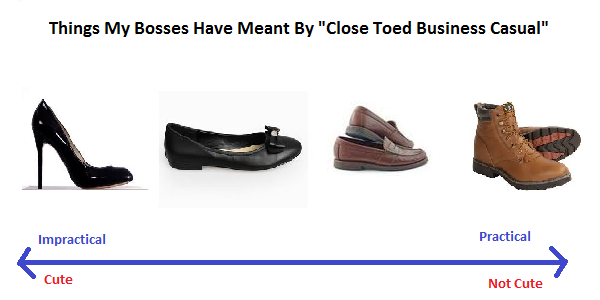
On the other hand, female engineers have the dreaded moment when they look at their dress code and see a simple requirement to wear “closed toed shoes”. My past HR departments argue that this allows for freedom, but I’ve found that it really means that women are expected to wear any one (but not all) of the following shoes:
     
As you can tell,  there is a direct linear relationship between how practical the shoe is and how likely you are to be mistaken for a lesbian. But technically, all of these options are “close toed”. And if you are a woman in engineering, then you probably thrive on technicalities.

I made the “close toed” argument once when I was trying to pass off a pair of flats as close toed at a last minute client site meeting (which had worked countless times in the past). My boss had not told me that there were any additional protective clothing requirements, so I hadn’t brought anything special. My client pointed out that while my shoes were close toed, they were open footed- and therefore were not “close toed” per his definition.

I didn’t have any other options, so he pulled his extra pair of smelly, beat to hell, size 13 work boots out of the bottom drawer in his filing cabinet and slid them across the table to me. I, of course, was not wearing socks and I wasn’t about to put this 20 year old rank pair of boots on barefoot. So I wore the boots on top of my flats, and tied the laces around my legs like ballet slippers to try and secure the shoes while I took measurements. It turns out that it is even harder to walk in two pairs of shoes with varying sizes than it is to walk in heels. My clients have teased me about this ever since, with several clients offering me the shoes off of their feet before we go to work.

After this embarrassing mishap, I am happy to report I invested in a pair of steel toed boots, and developed a simple solution that seems to define what shoes you should be wearing: for presentations, I suck it up and wear heels; for computer work or work confined to a cube, I wear flats; for work involving dangerous chemicals, I wear “women’s loafers”; and for work involving heavy machinery I wear steel toed boots. There you go every HR department for every company I’ve ever worked for, was that so hard?

Love,

Vanessa