Monday, July 15, 2013

How to Handle Your New IT Role As An Engineer


So I got through four years at college, graduated with an impressive engineering degree, and entered the “real world” by getting my first job at an engineering firm. What’s the first thing I noticed? It wasn’t a personalized nameplate in my own, brand new office, that’s for sure.


The first “I’m not in college any more” moment I had was when I walked into work and notice how old the rest of my office mates were.


I don’t care how mature you are or if your only friends were professors and grad students. I, too, have always hung out with people who were about one generation ahead of me, so I can assure you that I am used to some pretty wide age gaps. However, the difference in ages between my peers and me is immense. I lowered the average age of my department by ~5 years just by joining.
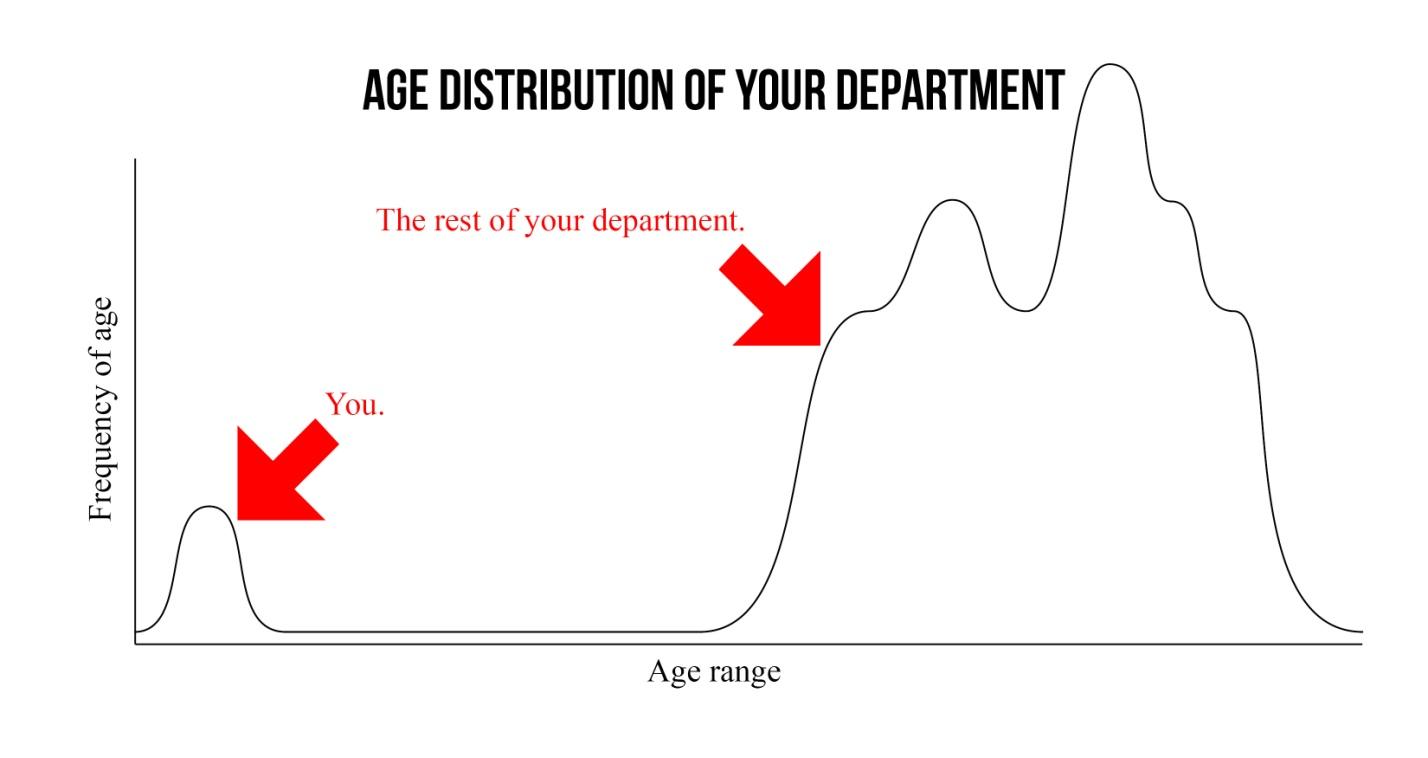


When you find yourself in this predicament, prepare yourself for being called the “baby” and for awkward conversations about how your coworkers’ kids (who happen to be your age) are also graduating college. But the biggest obstacle you will be faced with is the responsibility of teaching your coworkers everything about technology. And you will realize how much you take your knowledge of technology for granted when you have to teach someone:
  • How to copy and paste
  • How to crop a photo
  • How to filter junk mail
  • How to do other mundane, simple tasks

Your gut reaction will be to judge these people for their noob-ism because they are definitely judgment worthy. If you are able, you should quietly accept your job as the new IT person in the office. I, for instance, am now the go-to printer fixer in my office. Whenever a printer issue arises, my office mates call their new hire, Ruby, to save the day. And I readily drop my own projects to deal with the issue at hand, because what else can I say when my limited computer experience will gain me fame and glory in the eyes of my peers. However, the time I spend helping my coworkers fix paper jams and changing the toner is time not spent on my real, engineering projects. If you are like me, you may start to resent the naivety of your coworkers when it comes to simple technology issues.

After a period of time, however, you will be able to look past the computer-idiocy of some of your peers. Some of them have real intelligence and practical skills that are applicable and actually quite helpful to the job at hand. Granted, it will take you varied lengths of time to find this knowledge or skills in your peers. Some of them may hide their skills/knowledge for longer than their own lifespan. But with others, you will discover this fascinating, hidden facet of their professional life in just a few weeks.

So the next time you feel like sweeping everything off your desk in a dramatic gesture of exasperation because you were asked how to take a screenshot, just remember that someday your coworkers will impress you.

Best of luck,
Ruby

Monday, July 8, 2013

How to Avoid Dating Your Client's Children

Pretty much every woman in engineering has dealt with being courted by a co-worker, boss, client, etc. While I'm sure some fairy-tale romances have blossomed from the office, most of the time office courtships are weird and inappropriate. But eventually,  you accept it and learn how to fend off future advances.

I figured I'd escape the burden of trying to appear un-dateable with some of my coworkers and clients who are literally old enough to be my parents. Fortunately they tend to not be "manthers" (men who go after women half their age) and I make an effort to not dress like a flasher, so I thought I was in the clear. But what I'd never counted on was that they have sons who are just about my age. In the past year alone, I've had THREE clients/coworkers try to set me up with their children.

Each time is oddly similar. It's almost like people who are trying to set their children up with people at work have a well established method of how to bring up the idea of dating their very single child who may or may not even live in the same state as you.

So, I'm going to share the script of how co-workers try to bring up the idea of dating their children to help you prepare for a similar event. Or if you have a twenty or thirty something year old child who you've always wanted to set up a coworker, but just didn't know how to go about it,  this script is the perfect way to make your coworker extremely uncomfortable.  

PHASE 1: THE COMPLESTION


The awkward courting ritual always begins with a complestion (a compliment whose main purpose is to ask you an otherwise inappropriate question). They are usually focused around determining your age and/or if you are single. Take the following example:

Them: "You seem so young to be so knowledgeable about <subject matter>. How old are you anyhow?"

My guess is that the questioner expects that the target [in this case me] will be so overwhelmed by the compliment that they will unquestioningly share personal information,  which will determine if they are dateable.

PHASE 2: THE SNEAK


The true meaning of the complestion becomes revealed when they just happen to remember their own child's age:

Them: "You know what, I just remembered my son's just about the same age."

Typical reactions from the target include some confusion about how one forgets the age of his or her own child, and increased wariness of the nature of the conversation. 

PHASE 3: THE HOMAGE


Next comes the "homage" where I have the pleasure of receiving a sermon worshiping the perfection that is my client or coworkers son. He may not be a god, but he is damn close:

Them: "He was on the honor roll all through college, and then he joined the military saves a town of women and children and now he's got a great job. He's already been promoted twice because he's so smart, reliable, and he's just got a great personality. You know, everyone used to come up to me at little league games and tell me what great sportsmanship he has.  AND he's single right now,  but who wouldn't want to date a guy like that?"

Me (in my head): You know he does sound perfect for me, especially those part that you omitted about the smoking, anger management problems, and his clingy dependence on his parents.

Me (spoken aloud): "Sounds like your son is a great guy." (Spoken in the least encouraging tone possible without coming off as sarcastic, to try and discourage the continuation of the conversation).

PHASE 4: THE SUGGESTED MEETING

I never claimed to be an artist... 
The final phase of the wildly inappropriate attempted setup is the suggested meeting where the client/coworker comes up with some ridiculous way in which you can meet his or her son:

Them: "I think you'd really like him, maybe I'll get him to come in the next time we have a meeting and you two can chat afterwards."

Me: "..."

Honestly, I still haven't figured out how to respond to that one. Meeting a guy who is not affiliated with your company or your client during working hours seems all sorts of unethical. I am also skeptical of anyone who can manage to take off of work to meet me at 2 pm on a weekday. One of  my coworkers actually flew in their 28 year old son to for "bring your child to work day" and introduced him to me amidst a hoard of under-supervised screaming pre-teens. It was really romantic. Surprisingly,  we are not dating.

If you happen to experience all four phases of this set-up without having been able to stop it one way than you have officially entered the world of super awkward setups. Once you reach the final stage, beware: there is a strong implication that you should make something happen. My solution for this is simply to out-awkward  everyone else by acting as if I am completely unaware of their intentions. I've found that people feel exceedingly uncomfortable if they have to spell out the fact that they want you to date their child- which means that if you hold out in complete naivete long enough they give up and you can avoid the problem effectively all together.

Good luck,

Vanessa

Monday, July 1, 2013

How To Not Become A Flasher

There are some days when you leave your home thinking you’re going to have a normal day of meetings and sitting in your office, working at your computer. On those days, you might think it a good idea to deviate from your usual fashion of practical business casual wear. On those days, you might think it a good idea to finally wear that flowy skirt or new dress. After all, even though you work as an engineer and frequently disregard your girlish impulses in order to fit in, you are a girl and it is socially acceptable to wear skirts and dresses once in a while. If you are like me, you will be thinking, ‘What could it hurt to wear a dress on such a drab work day?’ 

Let this be a warning from personal experience: Disregarding your better (more practical) judgment to satisfy your girlish needs is not a good idea. Inevitably, the day you choose to wear a dress is the day you will be faced with some emergency which requires you to take apart and reassemble a malfunctioning piece of equipment, visit a client site which requires that you wear a pair of gross/moldy coveralls over your clothes, or even climb through air conditioning ducts superspy-style to end a dangerous hostage situation. 

In all of these cases, your girlish impulse to wear a dress is a hindrance. If your job is anything like mine, you have a 100% chance of flashing your coworkers while reassembling that mischievously malfunctioning piece of equipment. And if you attempt to do your job while consciously trying to avoid flashing your coworkers, you’re going to do it awkwardly and inefficiently. This is one of my greatest examples of a lose-lose situation. Either you are subject to embarrassment in front of your coworkers or your reputation takes a blow because of your inefficiency, all because you decided to wear a dress. 

After having experienced this first-hand, I have defined a new rule for choosing my work attire: Do not wear dresses. Do not try to try to make a fashion statement. Do not try to overthrow the suppression that your workplace practicality has imposed. This is one of those moments where it is a good idea to suck it up and bear it. 

I now intend to put a sign on my closet which reads something like this:

"Oh you want to wear a dress? No you don't. Put it back and grab those pants. Flashing is reserved for sex offenders and camera bulbs.

And if you’re having a hard time choosing what to wear, my friend Vanessa has kindly already provided some advice on what footwear is appropriate in the workplace. 

Now, avoiding wearing girly clothing just because of some hypothetical, superlative situations may sound suppressive or even discriminatory against women. I, however, don’t consider my advice anti-women or anti-feminism. In fact, I consider this choice in attire to be helpful to gaining women respect and rights. 

The reality is that I’m an engineer AND a feminist, which means I tend to go about obtaining respect for women in a practical manner. In my mind, women shouldn’t demand respect just because they are women. They need to earn respect by doing respectable things. Flashing my coworkers in a 100% avoidable situation doesn’t gain me respect; it actually discredits me. My coworkers will think of me as that girl that tries to do a man’s job instead of as just a coworker doing an engineer’s job.

Alternatively, if I dress appropriately for the job, as a typical engineer would (in practical, reasonable attire because we engineers are practical people), then I will hopefully be thought of as an engineer first. My reputation won’t be degraded, I won’t be embarrassed, and I’ll still be on par with all my other coworkers. Being thought of as an engineer who happens to also be a woman shifts the paradigm toward people understanding that everyone is capable of being an engineer regardless of gender. 

After all, women deserve respect in the workplace, and I simply can’t get that if I’m flashing everyone. Plus, by going about this reasonably, I’m able to combat the notion that women are unfathomable, illogical, and flighty creatures.

I, at least, will be removing skirts and dresses from my work attire from now on.

Monday, June 24, 2013

How to Make the Most of Your Internship

'Tis the season for summer internships! Whether you are in high school or university, being thrown into a company for a three month work marathon can be a daunting task. I've had a lot of internships, and made my fair share of mistakes along the way. Now I have a lot of interns working for me, so I've had time to compile a list of 10 tips for making the best of your internship while my interns do my busy work (just kidding... Sort of).

1) Internships are three month long interviews. It's easy to forget this once you get comfortable in your position, but keep in mind your performance will decide if you are offered a future position.

2) You will need somebody to give you a recommendation. Talk with your boss and at least one other full time person at the company regularly enough so that they can give you personal recommendations for your next internship or job. Even if you absolutely hate the internship, you may need these contacts for up to seven years after you finish your  internship.

3) You don't need a degree to be a great engineer. Just because you haven't finished your degree program doesn't mean you can't make some major contributions to a company. Don't be afraid to take ownership of your tasks, and express your ideas.

4) Internships are not summer camps. While it is a great opportunity to meet some awesome new people and go to company organized fun, your internship is still a job not a vacation.

5) Use your internship as an opportunity to network. Most engineering students I know end up interning at more than one company. Use your summer as an opportunity to network not just with full time employees, but other interns. You never know where people will end up, the engineering community is actually a pretty small world.

6) Don't over-commit yourself. One of the biggest mistakes I made was taking difficult college courses while working full time at an internship. If you end up with a big deadline for work and a midterm- something has to give. Not only was I not able to give either my internship or my classes the level of attention I would have liked, but I started the school year completely burned out. If possible, take the summer as an opportunity to focus on one thing so you can go back to your school refreshed and ready for another year.

7) Don't be afraid to ask questions. Asking questions is not a bad thing. As an intern it is expected that you will have a steep learning curve at the beginning of your work (unless you are put in the unfortunate position of coffee runner and photocopier). Just make sure to listen carefully to the answer- because asking the same question multiple times can make it seem like you are incompetent or don't care.

Picture thanks to Ruby Stubson
8) Be wary of the line between work and personal life. This line can be very blurry in internships, especially those where housing is provided and shared with other interns. But nothing in company housing stays secret for long.

9) You are competing with other interns for a job offer. People have a tendency to compare interns to one another.  So while being a team player is important, you should also make a special effort to not fall behind the curve.

10) Use your internship as an opportunity to learn about what you want in an employer. Compile a mental or physical list at the end of each summer about what is important for you to have in a workplace. This will come in handy when you are coming up with questions for future interviews, and making the decision between multiple offers.

Good luck. Go own that internship.

Love,

Vanessa

P. S. Do YOU have any tips for engineering and science interns?  Leave them in the comments below!

Monday, June 17, 2013

How to Not be an Anti-Feminist

DISCLAIMER: I realize this post is lacking my normal humor, but some issues need to be addressed more seriously.

As a professional female engineer I am constantly fighting stereotypes.  Some people see  me and think I'm a secretary. Some people assume I'm dumb and just got the job because I'm a woman.  Some people assume my gender precludes me from certain types of work. While it's weirdly fulfilling to shock people with my ninja engineering skills,  it definitely can wear on me.

The easy solution is to blame these associations on the men that dominate the profession,. But the truth is  some of the biggest opposition in making engineering a normal job for women is actually other women.

In engineering,  I've come across a spectrum of women:

Note that this is a spectrum, and that not all women fall into a single category

On one extreme is the ultra feminist who constantly points out oppression.  She asks that women not be forgotten, and constantly reminds people of the gender divide.

In the middle is the woman who counts herself as equal to (not better than) male counterparts. When at work her focus is her job, not her gender.

On the other extreme is the woman who was forced into engineering and is waiting to get married. She asks that men continue to treat her as a "lady".

All three groups arguably have their issues, which I can discuss in a future post. But some members of group 3 voice their lack of passion for engineering in such a way that they reinforce damaging stereotypes -  holding the rest of women back. It is this group which I think can have the same impact as a misogynistic man, and which I believe warrants further discussion.

For example there is the case of Jane, a Type 3 engineer.  Jane is a 3rd generation engineer,  and a nth generation aspiring housewife. Whenever Jane gets work she doesn't want to have to do, she denies it because it is not "women's work" and would be shameful to undertake. Things that are not "women's work"  include : driving,  making large decisions rationally, and anything else she doesn't feel like doing that day. She also frequently asks if her clients will be young eligible bachelors when she is assigned a project. I wish I was joking.

The problem with this is not only that she is destroying her own reputation, but that the men who have worked with her for years come to actually believe that there is such a thing as "women's work"  and hesitate assigning projects to other women. Several men have voiced concern when assigning me complex tasks, since Jane had previously complained that it was "man's work". In my mind,  this is the single most damaging thing to the inclusion of women in the workplace -  because while men can be punished for expressing that women are unable to complete tasks as a result of their gender,  women are less likely to be chastised for the same behavior. And, generalizations are more likely to be considered true when they are endorsed by a member of that group.

While I understand that behavior in Jane and others like her is not necessarily driven by a hatred of other women, I believe it is driven by an appalling lack of respect for the capabilities of women. The damage that this behavior causes, and the number of women who can be negatively impacted by the actions of just one other woman is staggering.

In order to prevent this damage, we each do two simple things to help change the world's perception of female engineers:

1) Attribute your own likes and dislikes and strengths and weaknesses to yourself instead of your gender.  We are all individuals and have different tastes and interests.

2) Encourage women to pursue a career they are passionate about (not necessarily just engineering).  There is a thin line between encouraging someone to consider a different field and forcing her to join a career which does not interest her.

Each one of us has the power to impact how society views female professionals, so if we all take simple measures we can make the lives of other women just a little bit easier.

Love,

Vanessa

Monday, June 10, 2013

How to Avoid the Hangry Pains


My lunch for today consisted of an apple, a granola bar, six Hershey’s Kisses, and a juice box. It’s not the healthiest lunch, I know. And it’s not really the type of brain food I was hoping to have while developing my next experiment. However, there wasn’t much I could do about it. That happened to be all the food I could find stashed in my desk today.


I try to be good about brown-bagging my lunch most days. After all, bringing your lunch has all those great advantages like saving money and eating healthier. Except, somehow, life seems to thwart my plans of health and budgeting with its habitual obstacles. So, on those days, instead of packing myself lunch, I plan to eat in the cafeteria or go out to a local restaurant (read: fast food joint).

Unfortunately, most of my days of planning to outsource lunch prep happen to also fall on disorganized and hectic days. Today was one of those days where the forces of the universe collided and cause me to not bring a lunch, to have a busy work day, and to have forgotten my wallet.

Such days are bad days. Days like today cause the hangry pains – you know, when you’re hungry AND angry. Or become angry because you are hungry. Days like today result in some behavior like:
a)       Stalking the lunch room hoping someone has left a box of donuts for people to eat
b)       Pouncing on people’s leftovers like a vulture
c)       Crawling around the parking lot looking for change to use in a vending machine
d)       Any other type of unsettling, unprofessional behavior

However, there’s a step you can take to avoid acting like a hyperactive squirrel and grabbing all the food in sight. Take my advice: start to create a stockpile of snacks in the bottom drawer of your desk. And yes, I realize that my squirrel analogy has failed because you’ll be stashing food for when it becomes scarce later.

Honestly, though, having a cache of food for the days when everything goes wrong is the easiest solution. That way, when you forget your wallet, your lunch, and your zen state of mind, you can just reach into your desk for a granola bar, an apple sauce, and an instant cup of soup. It’s not the most healthful lunch, but it’ll be sufficient to abate the hangry pains, thus saving your reputation and potentially your job. 

Best of luck, 
Ruby

Monday, June 3, 2013

How To Not Get Hep A from Coworkers

WARNING: This article is not for the squeamish.

So, you work with a lot of men. Well sister, I've got an unpleasant realization for you: a lot of those guys do not wash their hands. According to a 2009 study by the London School of Hygiene and Tropical Medicine only 31% of dudes wash their hands after using a public bathroom. My private research shows it is a little closer to 60%, which is still disgustingly low.

But Vanessa, how do you know how many men wash their hands? I'll tell you. I have a coworker who loves to complain, and who as over time compiled a list for me of all of the men who don't wash their hands at work. Given, a single violation puts you on the "filthy" list for good- so this doesn't account for the casual hand washer who sometimes just is too busy to follow through and clean the feces off of his hands.

But it shouldn't account for the casual hand washer. Because that is gross.

Now, think of knowing that all these people don't ever wash their hands and then having to shake their hands, and share pens, pencils, calculators, tools and computers with them. Some of the more extreme offenders apparently even bring business papers and business calls into the stall with them. Gross. I strongly suspect this is why people in workplaces tend to get sick so often.
Is it just me, or does the context make this photo seem super gross?
At this point, I know the mysophobes among you are wishing you could rock one of these babies to work:

Germs be gone!
Alas, it simply does not comply to business casual standards.

BUT ALL HOPE IS NOT LOST. Just get a giant bottle of Purell. And if you know somebody doesn't wash his hands (because I've honestly never seen a girl leave a bathroom without washing her hands), then douse everything in sanitizer when they leave. Try to do this as quickly and quietly as possible, as people tend to get easily offended when they realize you think you are going contract a disease from them.

You may now live a happy, healthy, Hep A free life.

Love,

Vanessa